

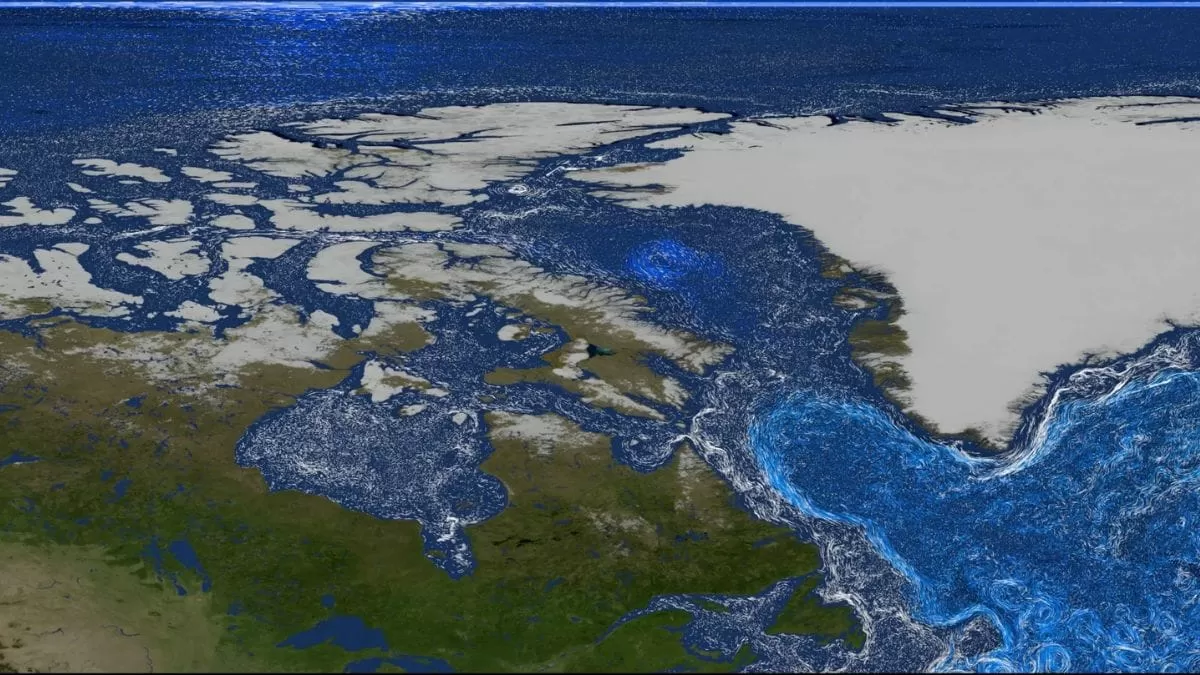
A new study by NASA has shed light on the surprising impact of Greenland’s melting glaciers on the Arctic Ocean. The study, led by NASA, reveals that the massive freshwater plumes from melting glaciers are actually fueling life in the Arctic Ocean. This finding is crucial in understanding the effects of climate change on our planet and the delicate balance of life in our oceans.
Each summer, glaciers like Jakobshavn, one of the fastest-moving and largest glaciers in Greenland, release massive amounts of freshwater into the Arctic Ocean. This freshwater, which is rich in nutrients, is dragged upward by deep-sea currents, creating a phenomenon known as “glacier plumes”. These plumes provide a vital source of nutrients to the surface waters of the Arctic Ocean, boosting phytoplankton growth by up to 40%.
Phytoplankton are microscopic organisms that play a crucial role in the marine food web. They are the base of the ocean’s food chain, providing food for a wide range of marine animals, from tiny zooplankton to large whales. Not only do they serve as a food source, but they also play a key role in the absorption of carbon dioxide from the atmosphere, helping to regulate our planet’s climate.
Using NASA’s Earth Observing System (EOS), scientists were able to observe and measure the impact of these glacier plumes on phytoplankton growth in the Arctic Ocean. The study, published in the journal Nature Communications, found that the increase in phytoplankton growth due to glacier plumes is equivalent to the annual carbon emissions of 2.2 million cars.
This finding is significant because it shows that the melting of Greenland’s glaciers, which is often seen as a negative consequence of climate change, has a positive effect on the ocean ecosystem. The freshwater from the melting glaciers acts as a natural fertilizer, providing the nutrients that phytoplankton need to thrive. This, in turn, benefits other marine animals and helps to regulate the Earth’s climate.
The study also highlights the importance of understanding the complex interactions between different components of our planet’s ecosystem. The researchers involved in the study hope that their findings will help to improve climate models and aid in predicting the effects of climate change on our oceans.
This is not the first time that NASA’s EOS has been used to study the effects of climate change. In fact, the agency’s satellite data has been crucial in understanding the changing dynamics of our planet’s environment. From tracking the melting of polar ice caps to monitoring the health of coral reefs, NASA’s EOS has provided valuable insights into the state of our planet.
The findings of this study also have implications for other regions of the world where glaciers are melting, such as the Antarctic. The researchers believe that similar processes may be occurring in the Southern Ocean, which could also have a significant impact on the marine ecosystem and carbon absorption.
While this study brings to light a positive aspect of melting glaciers, it is important to note that the overall effects of climate change on our planet are still largely negative. The increasing temperatures and melting of glaciers are causing sea levels to rise, leading to coastal erosion and threatening the habitats of many species. This study serves as a reminder that we must take urgent action to address climate change and protect our planet.
In conclusion, the new NASA-led study has revealed a surprising and positive effect of Greenland’s melting glaciers on the Arctic Ocean. The freshwater plumes from these glaciers provide a vital source of nutrients, boosting phytoplankton growth and aiding in carbon absorption. This finding highlights the delicate balance of life in our oceans and the importance of understanding the complex interactions within our planet’s ecosystem. With the help of NASA’s Earth Observing System, we can continue to monitor and understand the effects of climate change on our planet and work towards finding solutions to protect our environment for future generations.