

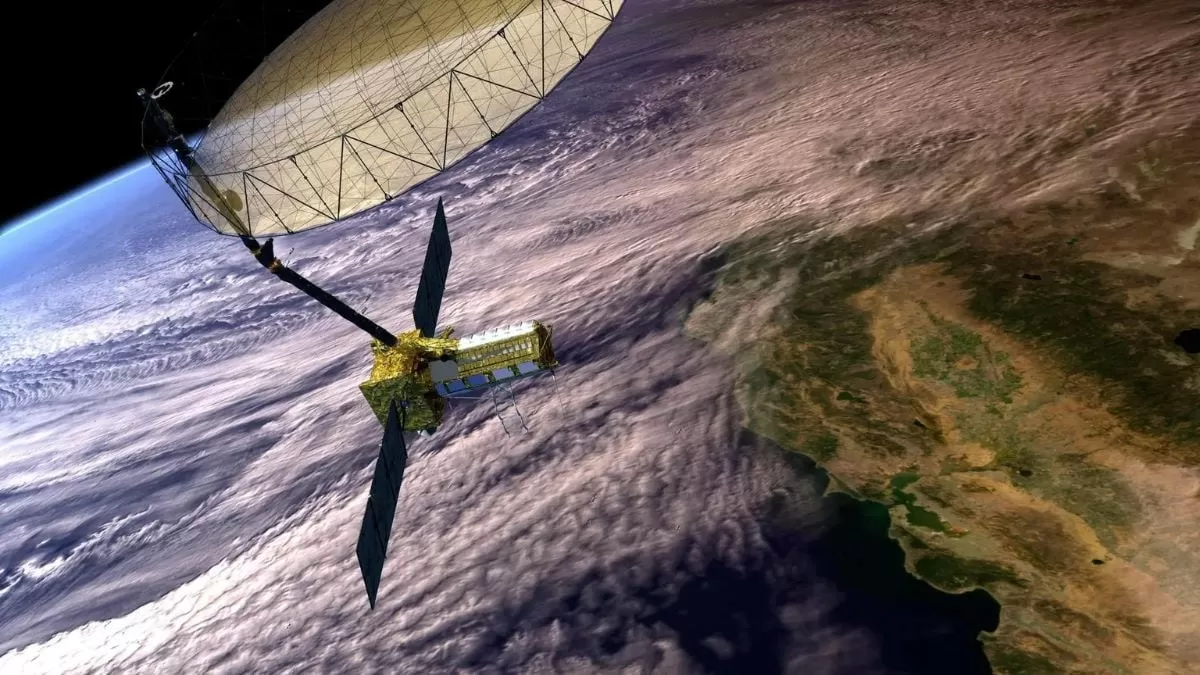
NASA and India’s ISRO are joining forces to launch a groundbreaking satellite that will revolutionize our understanding of Earth’s surface. Known as NISAR (NASA-ISRO Synthetic Aperture Radar), this first-of-its-kind satellite is equipped with advanced dual-band radar technology and is set to launch in late July 2025 from Sriharikota, India.
The collaboration between NASA and ISRO is a testament to the power of international cooperation in the pursuit of scientific advancement. NISAR will be a game-changer in terms of Earth observation, providing us with a wealth of data that will help us better understand our planet and its changes over time.
One of the most exciting aspects of NISAR is its dual-band radar system, which operates at both L-band and S-band frequencies. This means that the satellite will be able to capture images of the Earth’s surface in two different wavelengths, providing us with a more comprehensive and detailed view of our planet.
The L-band radar will operate at a longer wavelength, allowing it to penetrate through vegetation and capture images of the Earth’s surface beneath. This will be particularly useful in monitoring changes in land cover, such as deforestation and urbanization. On the other hand, the S-band radar will operate at a shorter wavelength, providing us with high-resolution images of the Earth’s surface. This will be crucial in monitoring changes in ice cover, such as the melting of glaciers and sea ice.
But what truly sets NISAR apart is its ability to capture surface changes with centimeter-level precision. This level of accuracy is unprecedented in Earth observation satellites and will allow us to monitor even the smallest changes on the Earth’s surface. This is especially important in the face of climate change, as NISAR will provide us with valuable data on the impacts of global warming on our planet.
NISAR will also have a wide coverage area, mapping nearly all of Earth’s land and ice every 12 days. This means that we will have a continuous stream of data on the changes happening on our planet, providing us with a more complete understanding of Earth’s dynamic systems.
The satellite will also have a variety of applications, from monitoring natural disasters such as floods and earthquakes to tracking the movement of tectonic plates. It will also be used to study the Earth’s carbon cycle, helping us better understand the role of forests and oceans in regulating our climate.
The launch of NISAR marks a significant milestone in the partnership between NASA and ISRO. The two space agencies have a long history of collaboration, with ISRO providing critical components for NASA’s Mars missions and NASA assisting ISRO in its Chandrayaan lunar missions. This joint effort to launch NISAR is a testament to the strong bond between the two agencies and their commitment to advancing scientific research for the betterment of humanity.
The satellite will be launched on India’s Geosynchronous Satellite Launch Vehicle (GSLV) Mk II rocket from the Satish Dhawan Space Centre in Sriharikota, India. This launch site is strategically located near the equator, making it an ideal location for launching satellites into orbit.
NISAR’s launch is eagerly awaited by the scientific community and is expected to generate a wealth of data that will help us better understand our planet. The satellite will also be a valuable tool for policymakers and decision-makers, providing them with crucial information to make informed decisions for the benefit of our planet.
In conclusion, the launch of NISAR is a significant step forward in our understanding of Earth’s surface and its changes over time. With its advanced dual-band radar technology, centimeter-level precision, and wide coverage area, NISAR is set to revolutionize Earth observation and provide us with valuable insights into our planet. This joint effort between NASA and ISRO is a shining example of international collaboration and a testament to the power of science in bringing nations together for a common cause. We eagerly await the launch of NISAR and the wealth of knowledge it will bring us about our home planet.