

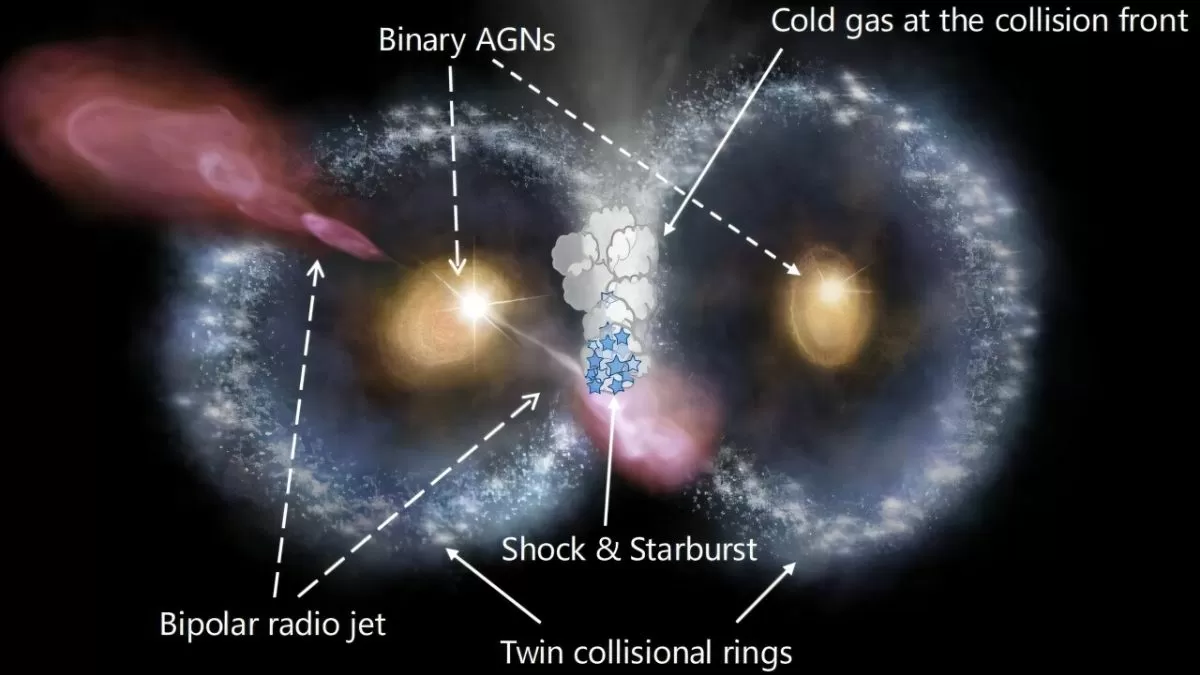
NASA’s James Webb Space Telescope has once again captured a stunning image that has left the scientific community in awe. The newly unveiled image, dubbed the “Cosmic Owl,” shows two colliding ring galaxies, formed in a structure that resembles an owl’s face. This incredible double-ring formation is extremely rare and has provided researchers with valuable insights into galaxy evolution, black hole dynamics, and rapid star formation.
Led by Ph.D. student Mingyu Li of Tsinghua University in Beijing, a team of international astronomers used the powerful capabilities of the James Webb Space Telescope to capture this breathtaking image. Launched in December 2021, the telescope is a joint project between NASA, the European Space Agency, and the Canadian Space Agency. It is the largest and most powerful space telescope ever built, with a 6.5-meter primary mirror, which is five times larger than the Hubble Space Telescope.
The “Cosmic Owl” image is a result of the telescope’s Near-Infrared Camera (NIRCam) and Near-Infrared Spectrograph (NIRSpec) working together. These instruments captured the faint light emitted from the galaxies at near-infrared wavelengths, providing a clear and detailed view of the collision event. The galaxies, located approximately 704 million light-years away from Earth, are part of a galaxy cluster known as Arp 285 and are believed to have collided around 1.4 billion years ago.
According to the lead author Mingyu Li, the formation of the “Cosmic Owl” is a rare occurrence, happening only once every 100,000 years. He further explained that the double-ring structure is a result of gravitational interactions between the two galaxies, causing gas and stars to be pulled outward from the center, creating a ring-like structure. This phenomenon is known as a “cartwheel” galaxy, and it is the first time it has been observed in a collision between two galaxies.
The image has provided astronomers with a unique opportunity to study the effects of galaxy collisions on star formation and black hole dynamics. The rings of stars seen in the image are regions of intense star formation, with young, massive stars being born at an unusually high rate. This is due to the gravitational forces exerted during the collision, causing gas and dust to compress and ignite into stars. This rapid star formation is crucial in understanding the evolution of galaxies and the formation of new stars.
Furthermore, the “Cosmic Owl” image also reveals the presence of two supermassive black holes at the center of each galaxy. As the galaxies collide, the interacting black holes are expected to merge, creating a more massive and active black hole. This process can also trigger intense bursts of high-energy radiation, which can be detected by the telescope’s instruments. By studying these black holes, astronomers hope to gain a better understanding of their role in galaxy evolution.
The James Webb Space Telescope’s unparalleled capabilities have once again proven its worth in unlocking the secrets of the universe. With its ability to see further and clearer than any other telescope before, it has opened up a new realm of possibilities for scientific research. The “Cosmic Owl” image is just one of the many incredible discoveries that await us in the future.
The success of this mission is a testament to the hard work and dedication of the team behind it. From the engineers and scientists who designed and built the telescope to the astronomers who operate and analyze the data, this achievement is a result of a collaborative effort. It is a reminder of the incredible feats that can be achieved when we work together towards a common goal.
The “Cosmic Owl” image has captured the imagination of people all around the world, inspiring wonder and curiosity about the vastness and complexity of our universe. It is a reminder that there is still so much we have yet to discover and understand. The James Webb Space Telescope continues to push the boundaries of what we thought was possible, and it is only the beginning of a new era of space exploration and discovery.