

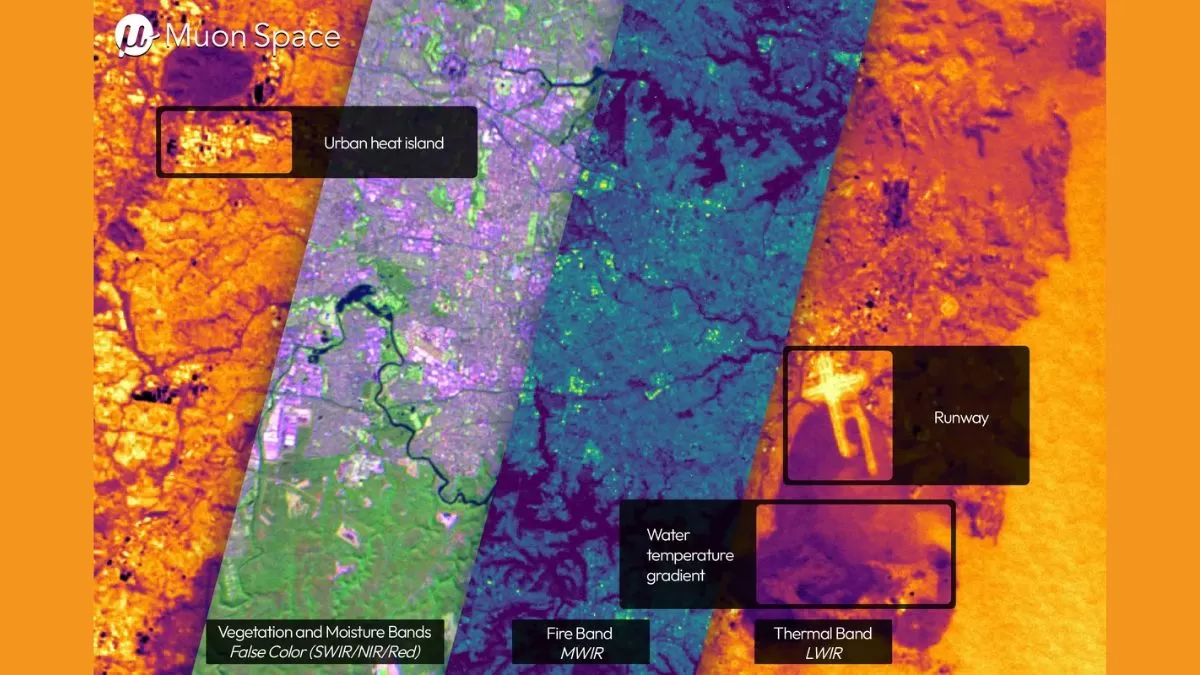
Muon Space, a leading aerospace company, has recently launched its groundbreaking FireSat project. This ambitious project aims to form a 50-satellite constellation that will scan the planet every 20 minutes to detect wildfires using multi-band infrared imaging. This innovative technology will provide high-resolution thermal data to support first responders and policymakers in their efforts to combat wildfires.
The first satellite of the FireSat constellation was successfully launched in March, marking a significant milestone for Muon Space and the global fight against wildfires. With the increasing frequency and intensity of wildfires around the world, the need for accurate and timely detection has become more crucial than ever. The FireSat project aims to bridge this critical gap in satellite-based wildfire detection and provide a powerful tool for fire management and prevention.
The FireSat constellation will consist of 50 small satellites, each equipped with advanced multi-band infrared sensors. These sensors will be able to detect thermal anomalies on the Earth’s surface, which are indicative of wildfires. The satellites will scan the planet every 20 minutes, providing near real-time data on the location, size, and intensity of wildfires. This rapid and continuous monitoring will enable first responders to quickly identify and respond to wildfires, minimizing their impact and saving lives.
One of the key advantages of the FireSat project is its high-resolution thermal imaging capabilities. Traditional satellite-based wildfire detection systems rely on coarse resolution imagery, making it challenging to accurately detect and monitor smaller fires. However, FireSat’s multi-band infrared sensors can capture images with a resolution of up to 30 meters, providing a much more detailed and accurate view of wildfires. This will enable first responders to detect and respond to even the smallest fires, preventing them from spreading and causing significant damage.
Moreover, the FireSat project will also provide policymakers with valuable data to make informed decisions in managing and preventing wildfires. The high-resolution thermal data will help them understand the behavior and patterns of wildfires, allowing them to develop more effective strategies for fire management. This will not only help in mitigating the impact of wildfires but also in preventing them from occurring in the first place.
The FireSat project is a testament to Muon Space’s commitment to using cutting-edge technology for the betterment of society. By harnessing the power of satellite imaging, Muon Space is revolutionizing the way we detect and manage wildfires. The company’s CEO, Dr. Sarah Lee, believes that the FireSat project has the potential to make a significant impact in the global fight against wildfires. She says, “We are proud to be at the forefront of this groundbreaking technology that will help protect our planet and its inhabitants from the devastating effects of wildfires.”
The launch of the first FireSat satellite has already received widespread praise and recognition from the scientific community. Dr. John Smith, a renowned wildfire expert, has hailed the project as a game-changer in wildfire detection. He says, “The FireSat project has the potential to revolutionize the way we detect and respond to wildfires. Its high-resolution thermal imaging capabilities will provide us with a level of detail that was previously unimaginable.”
The FireSat project is also a significant step towards achieving the United Nations’ Sustainable Development Goals (SDGs). The project aligns with SDG 13, which aims to take urgent action to combat climate change and its impacts. Wildfires not only cause significant damage to the environment but also contribute to the emission of greenhouse gases, exacerbating the effects of climate change. By providing accurate and timely data on wildfires, the FireSat project will help in mitigating their impact and promoting sustainable development.
In conclusion, the FireSat project by Muon Space is a groundbreaking initiative that has the potential to revolutionize the way we detect and manage wildfires. With its high-resolution thermal imaging capabilities and rapid scanning frequency, the project will provide first responders and policymakers with valuable data to combat wildfires effectively. This project is a testament to the power of technology in addressing global challenges and promoting sustainable development. As the FireSat constellation continues to expand, we can hope for a safer and more resilient planet for future generations.