

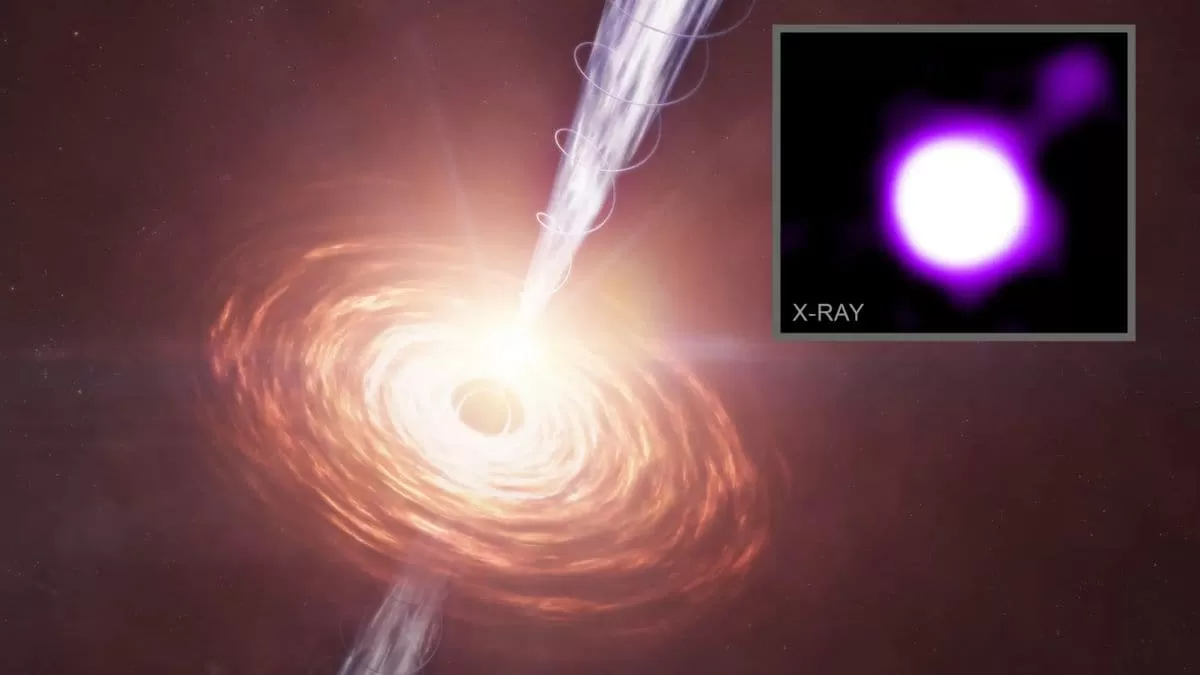
NASA’s Chandra telescope has once again made a groundbreaking discovery, this time from a distance of over 11.6 billion light-years away. The telescope has spotted two incredibly powerful black hole jets during the universe’s cosmic noon, revealing rare high-speed behavior that has been boosted by remnants of the Big Bang. These findings, which take into account relativistic effects, have shed new light on the early growth of black holes and will soon be published in The Astrophysical Journal.
The Chandra X-ray Observatory, operated by NASA, has been instrumental in unraveling the mysteries of the universe since its launch in 1999. Over the years, it has captured some of the most stunning images of celestial objects, giving us a deeper understanding of the vastness and complexity of space. And now, it has added yet another incredible discovery to its long list of achievements.
Black holes, one of the most fascinating and enigmatic objects in the universe, are known for their immense gravitational pull that sucks in everything that comes in their way, even light. But what makes this recent discovery even more remarkable is the fact that these jets were spotted during the cosmic noon, a critical time in the evolution of the universe.
According to astronomers, the cosmic noon refers to a period of intense star formation and black hole growth in the early universe. It is a time when galaxies were actively forming, and the universe was at its most energetic state. The fact that these powerful black hole jets were found during this crucial period has given us a rare glimpse into the early stages of black hole growth.
The two jets, known as SDSS J1354+1327, were first discovered in 2016 by the Sloan Digital Sky Survey. But it wasn’t until the Chandra telescope captured the X-ray images that the true magnitude of their power was revealed. These jets are estimated to be over 100,000 light-years long, making them one of the largest ever observed.
But what makes these jets even more intriguing is their speed. They are moving at an astonishing rate of 98% the speed of light, which is close to the theoretical maximum speed in the universe. This means that these jets are traveling at almost the speed of light, making them some of the fastest-moving objects ever observed.
The Chandra telescope was able to capture these jets in such detail due to its ability to detect X-rays, which are produced when matter is heated to extremely high temperatures. As the jets travel through the universe, they collide with gas and dust, creating a shockwave that heats up the surrounding material to millions of degrees, emitting X-rays that can be detected by the telescope.
But what is even more remarkable is the fact that these jets are being powered by the remnants of the Big Bang. The Big Bang, which is believed to have created the universe, left behind a vast amount of energy that is still present today. This energy, known as the cosmic microwave background radiation, has been found to have a significant impact on the growth of black holes. In the case of these two jets, the cosmic microwave background radiation has boosted their speed and power, giving us a unique opportunity to study the effects of the Big Bang on black hole growth.
The findings of this study have opened up new avenues for research and have given us a better understanding of the early evolution of black holes. It has also provided us with valuable insights into the role of the cosmic microwave background radiation in shaping the universe as we know it today.
Dr. Marco Chiaberge, an astrophysicist at the Space Telescope Science Institute in Baltimore, Maryland, and lead author of the study, says, “This is an exciting discovery that has given us a new perspective on the growth of black holes in the early universe. The fact that we were able to detect these jets from such a great distance and during the cosmic noon is a testament to the capabilities of the Chandra telescope.”
The Chandra telescope has truly revolutionized our understanding of the universe and continues to push the boundaries of what we thought was possible. Its latest discovery of these two powerful black hole jets has once again highlighted the importance of space exploration and the need for advanced technology to unravel the mysteries of the universe.
As we continue to delve deeper into the mysteries of space, discoveries like these will play a crucial role in expanding our knowledge and giving us a better understanding of our place in the universe. And with the advancements in technology and the dedication of scientists and researchers, we can