

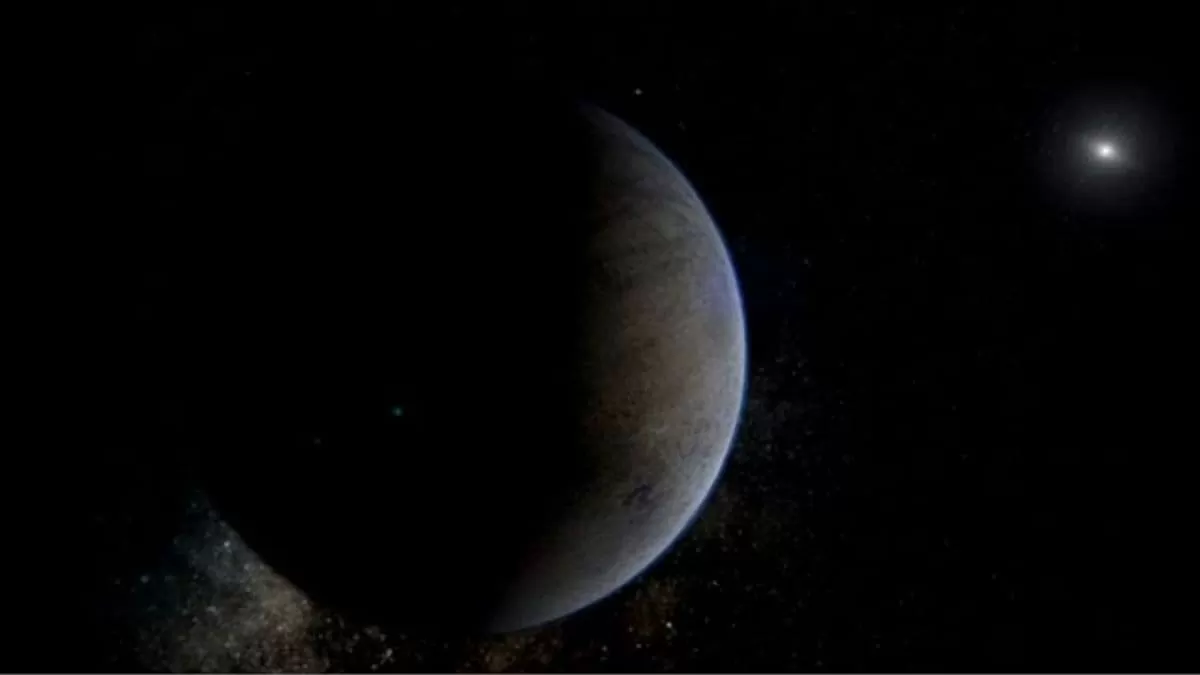
The vast expanse of space has always held many mysteries for us as human beings. And just when we think we have a grasp on our understanding of the universe, a new discovery comes along and reshapes our perspective. Such is the case with the recent discovery of a potential dwarf planet, 2017 OF201, in the farthest reaches of our solar system.
Located beyond the orbit of Neptune, 2017 OF201 is believed to be the farthest known object in our solar system, at a distance of about 120 astronomical units (AU) from the Sun. To put that into perspective, 1 AU is the distance between the Earth and the Sun. This means that 2017 OF201 is 120 times farther away from the Sun than our planet is.
But what makes this discovery even more fascinating is the fact that 2017 OF201 has a highly elongated orbit, unlike any other known object in our solar system. It takes this potential dwarf planet about 1,000 years to complete one orbit around the Sun, and its orbit is tilted at an angle of about 54 degrees to the rest of the planets in our solar system.
This unique orbit has caught the attention of astronomers and has sparked a heated debate about its implications for our understanding of the solar system. One of the main points of discussion is its contradiction of the Planet Nine hypothesis.
The Planet Nine hypothesis, put forward by astronomers Konstantin Batygin and Michael Brown in 2016, suggests the existence of a ninth planet in our solar system. This hypothetical planet was proposed to explain the clustering of distant objects beyond Neptune, including Pluto. However, the highly elongated orbit of 2017 OF201 goes against this theory, as it does not show any signs of clustering with other distant objects.
This finding not only raises questions about the existence of Planet Nine but also challenges our current understanding of the formation and evolution of the solar system. It suggests that there may be other factors at play that we are yet to discover.
But this potential dwarf planet doesn’t just have a unique orbit. It also has a large size, estimated to be about 400 kilometers in diameter. This makes it comparable in size to Pluto, which was once considered the ninth planet in our solar system before being reclassified as a dwarf planet in 2006.
The discovery of 2017 OF201 was made possible by the Outer Solar System Origins Survey (OSSOS), a project aimed at studying the outer regions of our solar system. Using the Canada-France-Hawaii Telescope on Maunakea, Hawaii, the team of astronomers behind OSSOS was able to identify this potential dwarf planet among the countless objects in the outer solar system.
This groundbreaking discovery is a testament to the power of technology and the determination of scientists to unravel the mysteries of the universe. It also highlights the importance of continued exploration and research in the outer regions of our solar system, which hold many secrets waiting to be discovered.
But the implications of this discovery go beyond just the scientific community. It also has the potential to change the way we view our place in the universe. With the possibility of a large, distant planet like 2017 OF201, our solar system becomes even more diverse and dynamic. And as we continue to push the boundaries of our knowledge, we are reminded that there is still so much more for us to learn and discover.
This discovery also serves as a reminder of the vastness and complexity of our universe. It humbles us and sparks our imagination, leaving us in awe of the wonders that exist beyond our reach.
In conclusion, the discovery of a potential dwarf planet, 2017 OF201, in the farthest reaches of our solar system is a groundbreaking achievement that challenges our existing understanding of space. Its unique orbit and large size not only question the existence of a ninth planet but also open up new possibilities for further exploration and research. As we continue to make new discoveries, we are constantly reminded that there is still so much more waiting to be uncovered in the vast expanse of space.