

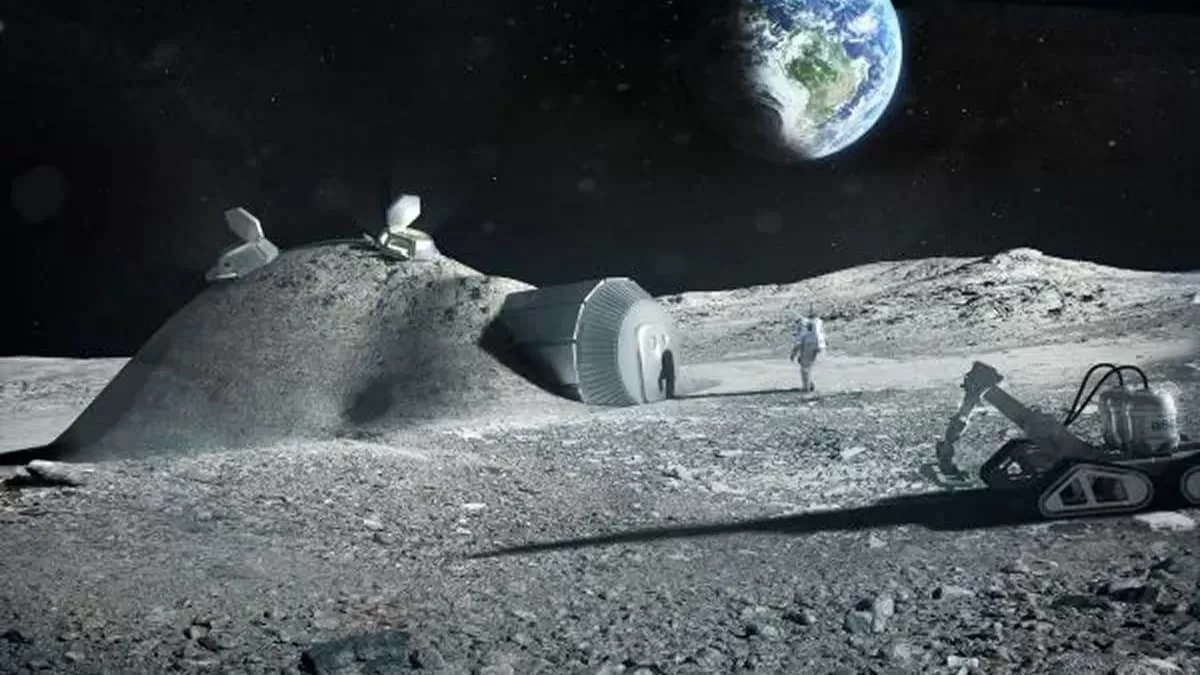
China and Russia have recently made a groundbreaking agreement that will propel their space exploration efforts to new heights. The two countries have agreed to build a nuclear-powered lunar station by 2036, with the aim of outpacing NASA’s delayed Artemis mission. This ambitious project will see the construction of a permanent research base at the Moon’s south pole, powered by a state-of-the-art nuclear reactor.
The deal, which was announced by Roscosmos, the Russian space agency, marks a major step in the joint plan for long-term lunar and Mars exploration by China and Russia. This partnership between the two space giants has the potential to reshape the future of space exploration and bring us closer to unlocking the mysteries of the universe.
The use of a nuclear-powered station on the Moon has several advantages over traditional solar-powered systems. Firstly, the lunar south pole receives almost constant sunlight, making it an ideal location for a solar-powered station. However, the Moon’s north pole experiences long periods of darkness, making it unsuitable for solar power. A nuclear reactor, on the other hand, can provide a constant and reliable source of energy, regardless of the location on the Moon.
The autonomous construction of the lunar station is also a remarkable feat in itself. This means that the station will be built by robots, reducing the risk to human lives and increasing efficiency. It also showcases the advanced technological capabilities of both China and Russia.
The permanent research base on the Moon’s south pole will be a major achievement for both countries. It will serve as a hub for scientific research and exploration, providing valuable data and insights into the Moon’s geology and potential resources. This will not only benefit China and Russia but also the entire international scientific community.
Moreover, the lunar station will also serve as a crucial stepping stone for future missions to Mars. The experience gained from building and maintaining a base on the Moon will be instrumental in planning and executing a successful mission to the Red Planet. This joint effort between China and Russia will undoubtedly pave the way for even greater achievements in space exploration.
The timeline of 2036 for the completion of the lunar station is ambitious, but both China and Russia have a proven track record of delivering on their space projects. China, with its recent successful landing of a rover on the far side of the Moon and its advancements in space technology, has established itself as a major player in the space race. Similarly, Russia has a long history of pioneering space exploration, with significant achievements like the first satellite, first human in space, and first spacewalk.
The partnership between China and Russia in space exploration is not a new phenomenon. The two countries have a history of collaboration in this field, with joint missions like the Shenzhou-6 and the China-Russia Space Cooperation Agreement. This latest agreement is a testament to the strong bond between the two countries and their determination to push the boundaries of space exploration.
While NASA’s Artemis mission has faced delays, this joint effort by China and Russia shows that the exploration of space is a global endeavor. It is not a competition between nations but a collective effort to unravel the mysteries of the universe and advance human knowledge. This new lunar station is a symbol of international cooperation and unity in our common goal of exploring beyond our planet.
In conclusion, the agreement between China and Russia to build a nuclear-powered lunar station is a significant milestone in the history of space exploration. It is a testament to the advanced technological capabilities of both countries and their determination to push the boundaries of what is possible. This joint effort will undoubtedly bring us closer to unlocking the secrets of the Moon and pave the way for future missions to Mars. The future of space exploration looks brighter than ever, thanks to the partnership between China and Russia.