

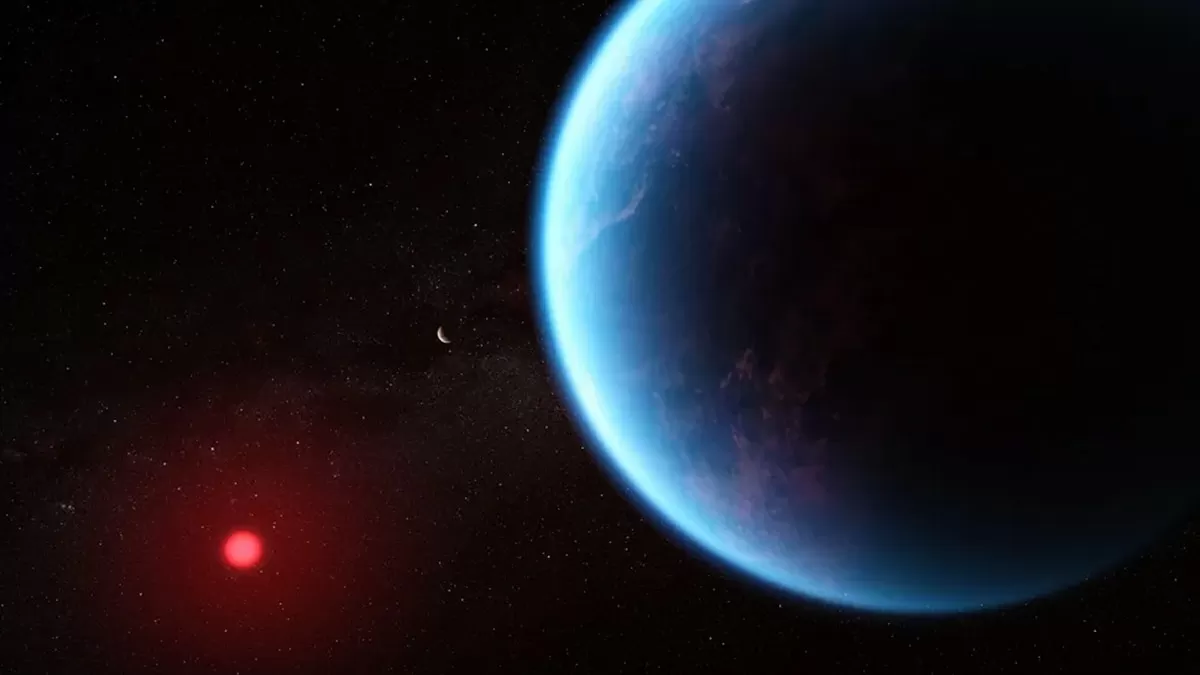
A new study led by researchers from the University of Chicago has reexamined data from the James Webb Space Telescope and found weaker evidence for potential signs of life on exoplanet K2-18b. This discovery challenges earlier reports that suggested the presence of a chemical called dimethyl sulfide (DMS), which is associated with marine life on Earth. The latest analysis reveals that the signals are inconsistent and could have alternative explanations.
Exoplanet K2-18b, located 110 light-years away from Earth, has been a subject of great interest for scientists due to its potential to harbor life. It is a super-Earth, meaning it is larger than our planet but smaller than gas giants like Neptune. The planet orbits within the habitable zone of its star, where temperatures are suitable for liquid water to exist on its surface. This makes it a prime candidate for hosting life as we know it.
In 2019, a team of researchers announced that they had detected the presence of DMS in the atmosphere of K2-18b. This chemical is produced by certain types of marine organisms on Earth and is considered a potential biosignature, or a sign of life, on other planets. The discovery sparked excitement and raised hopes of finding extraterrestrial life.
However, the new study, published in the journal Nature Astronomy, presents a different perspective. The team of scientists, led by Professor Raymond Pierrehumbert, reanalyzed the data from the James Webb Space Telescope and found that the signals attributed to DMS were not consistent with the expected patterns. This suggests that the chemical may not be present on K2-18b after all.
The researchers used a new technique called spectral deconvolution to analyze the data. This method separates the signals from different molecules in the atmosphere, allowing for a more accurate identification of their presence. The team found that the signals previously attributed to DMS could also be explained by other chemicals, such as hydrogen cyanide and ammonia, which are not necessarily indicative of life.
This new study highlights the importance of careful analysis and interpretation of data in the search for extraterrestrial life. While the earlier findings were exciting, they were based on limited data and assumptions. The latest analysis provides a more comprehensive understanding of the chemical composition of K2-18b’s atmosphere and raises doubts about the presence of DMS.
Professor Pierrehumbert explains, “We are not saying that there is no chance of finding life on K2-18b. But we need to be cautious and not jump to conclusions based on limited evidence.” He also adds that the team’s findings do not rule out the possibility of other biosignatures on the planet, and further research is needed to confirm or refute their presence.
The James Webb Space Telescope, set to launch in late 2021, will provide more advanced instruments and capabilities for studying exoplanets. This will allow scientists to gather more data and make more accurate observations, which could potentially lead to the discovery of life beyond Earth.
The search for extraterrestrial life is a complex and ongoing process. While the latest study may have weakened the evidence for DMS on K2-18b, it does not diminish the excitement and potential for finding life on other planets. As technology advances and our understanding of the universe deepens, we may one day find the answer to the age-old question: are we alone in the universe?
In conclusion, the new study by University of Chicago researchers has shed new light on the potential for life on exoplanet K2-18b. While the earlier reports of DMS in its atmosphere sparked hope, the latest analysis has revealed inconsistencies and alternative explanations. This highlights the need for cautious and thorough analysis in the search for extraterrestrial life. As we continue to explore the vastness of space, we may one day uncover the secrets of life beyond our planet.