

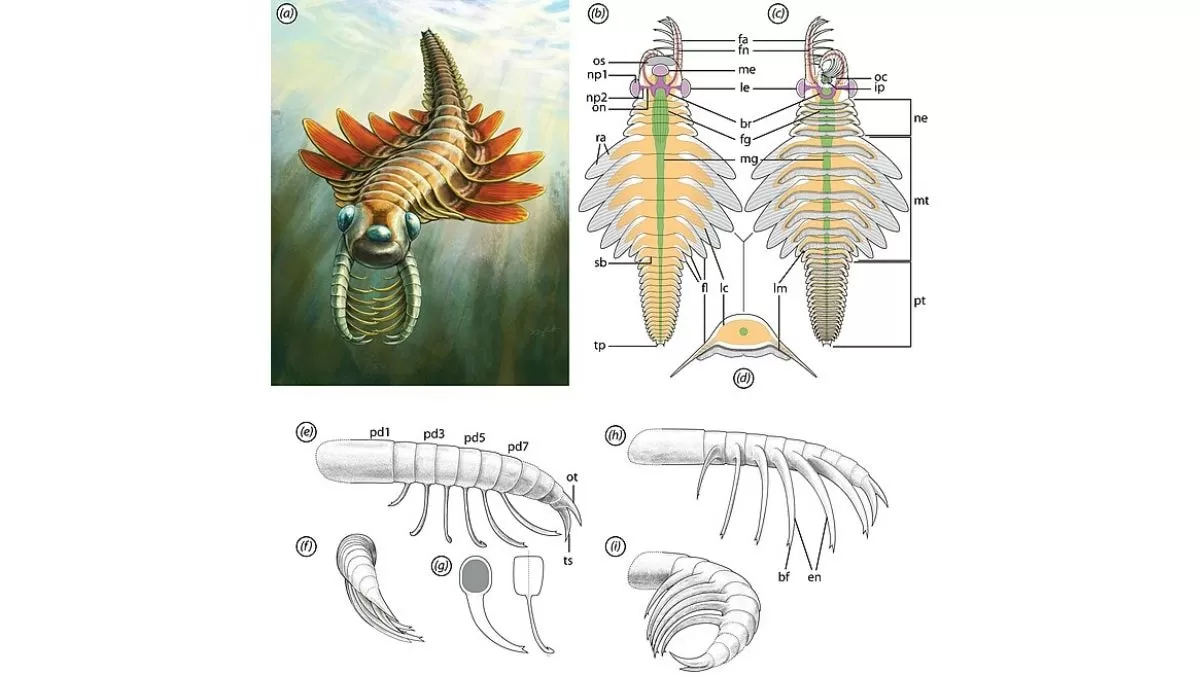
Paleontologists have made an exciting discovery in the world of marine predators – a three-eyed, finger-sized creature from half a billion years ago. This ancient creature, named Mosura fentoni after the Japanese monster Mothra, has been found in museum fossil collections in Canada.
The discovery of Mosura fentoni is significant for several reasons. Firstly, it adds to our understanding of the marine ecosystem from the Cambrian period, a time when life on Earth was rapidly evolving. Secondly, it showcases the incredible diversity of life that existed during this time, with creatures of all shapes and sizes inhabiting the oceans.
What makes Mosura fentoni stand out from other creatures of its time is its highly segmented body and unusually long gills on its rear. These features suggest that it may have evolved to adapt to low-oxygen environments, a theory supported by the fact that it was found in sedimentary rocks that were deposited in a marine setting with low oxygen levels.
The discovery of this ancient radiodont is a testament to the importance of museum collections and the tireless work of paleontologists. Mosura fentoni was originally collected in the mid-1990s by a team of researchers led by Dr. Jean-Bernard Caron from the Royal Ontario Museum in Toronto. However, it was only recently that Dr. Cédric Aria, a postdoctoral researcher at the Nanjing Institute of Geology and Palaeontology, identified it as a new species.
According to Dr. Aria, Mosura fentoni’s name was chosen to honor the iconic Japanese monster Mothra, known for its distinctive wings and ability to breathe fire. This choice of name not only adds a touch of pop culture to the scientific world but also highlights the creature’s unique features, such as its long gills that resemble wings.
The radiodonts, a group of ancient marine predators that Mosura fentoni belongs to, were some of the largest creatures of their time. They are known for their fierce hunting abilities, with their distinctive frontal appendages used to capture prey. However, Mosura fentoni’s small size and delicate features suggest that it may have had a different diet compared to its larger counterparts.
The discovery of this three-eyed creature also raises questions about the purpose of its third eye. While it is common for creatures to have multiple eyes, the exact function of the third eye in Mosura fentoni is still a mystery. It could have been used for detecting predators or for navigation in the murky waters of the Cambrian seas.
The study of ancient creatures like Mosura fentoni is crucial in understanding the evolution of life on Earth. The Cambrian period, in particular, is known as the ‘Cambrian Explosion’ due to the rapid diversification of life during this time. It marks a crucial point in Earth’s history, where the first complex animals emerged and laid the foundation for the diverse ecosystems we see today.
The discovery of Mosura fentoni also highlights the need for continued research and exploration. While many fossils have been uncovered, there are still countless more waiting to be discovered, providing a glimpse into the mysteries of our planet’s past.
In conclusion, the discovery of Mosura fentoni is a significant addition to the ever-growing list of ancient creatures that roamed the Earth millions of years ago. Its unique features and possible adaptations to low-oxygen environments make it a valuable addition to our understanding of the Cambrian period. This finding also serves as a reminder of the importance of preserving and studying museum collections, as they continue to provide valuable insights into our planet’s history. Who knows what other fascinating creatures are waiting to be uncovered in the depths of these collections?