

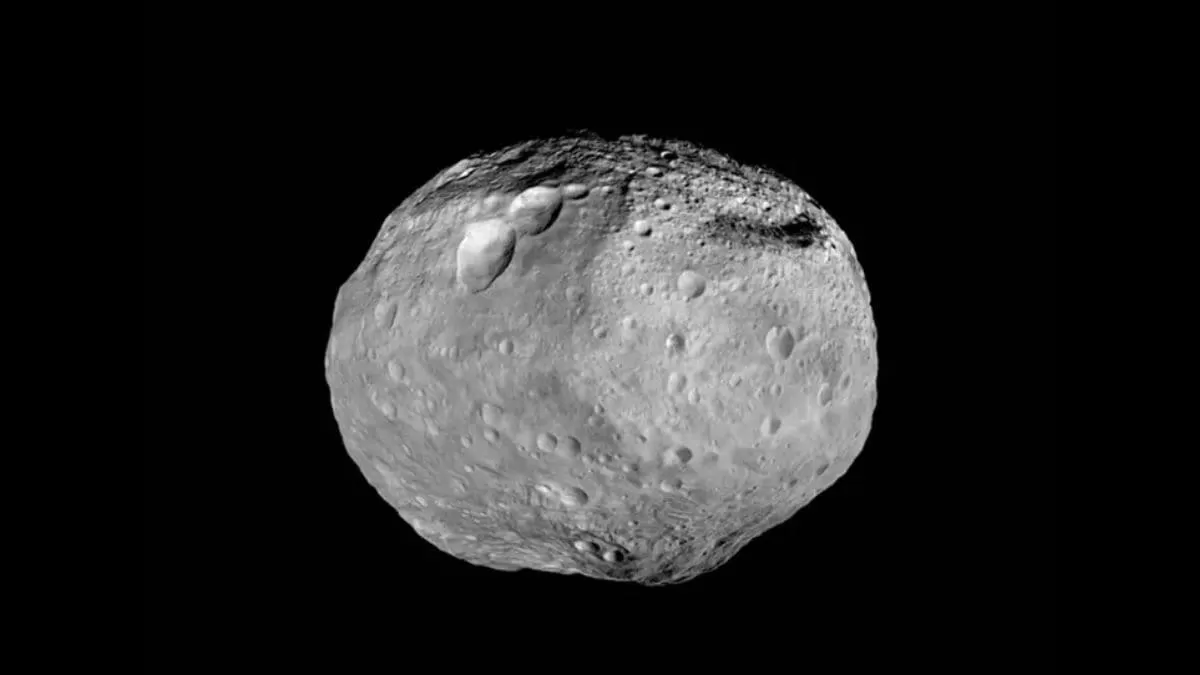
Vesta, the second largest asteroid in our solar system, has long been a source of fascination for scientists and space enthusiasts alike. With its distinct, colorful surface and intriguing history, Vesta has often been thought of as a stalled protoplanet – a celestial body that failed to fully develop into a planet. However, recent findings from NASA’s Dawn mission have shed new light on this enigmatic asteroid, leading scientists to believe that Vesta may actually be a fragment of a long-lost differentiated planet.
When the Dawn spacecraft arrived at Vesta in 2011, it began collecting data that would revolutionize our understanding of this asteroid. By using a highly sensitive instrument called a gravity gradiometer, the spacecraft was able to map the variations in Vesta’s gravitational field. This data, along with images and other measurements, allowed scientists to create a detailed picture of Vesta’s internal structure.
What they found was surprising – Vesta lacked a dense core, which had long been believed to be a defining characteristic of a protoplanet. Instead, the data showed that Vesta’s interior is more similar to that of a rocky planet, with a mixture of silicate materials and a lower density than originally thought. This suggests that Vesta was not a stalled protoplanet, but rather a piece of a larger, fully-formed planet that was violently shattered during a primordial impact.
This revised view of Vesta has sparked excitement and sparked new questions about the formation and evolution of our solar system. If Vesta is indeed a fragment of a differentiated planet, it could potentially change our understanding of how planets are formed.
The prevailing theory of planet formation is called the “accretion model”. According to this model, planets are formed from the accumulation of smaller bodies, such as asteroids and comets, through collisions and gravitational attraction. However, the new evidence from Vesta suggests that this model may not be as straightforward as previously thought.
The fact that Vesta lacks a dense core challenges the idea that all protoplanets eventually develop into fully-formed planets with defined layers. Instead, it supports the idea that some protoplanets may have been shattered during violent collisions, creating a mix of fragments that vary in size and composition. This new perspective on planetary formation could potentially reshape our understanding of how our own planet, Earth, came to be.
But the implications of this discovery don’t stop at Vesta. Scientists believe that this new understanding of Vesta’s formation could also apply to other asteroids in our solar system. In fact, there are currently over 800,000 known asteroids in our solar system, with many more yet to be discovered. Studying these small bodies can provide valuable insights into the early stages of planetary formation.
While Vesta may no longer fit into the category of a stalled protoplanet, its role in shaping our understanding of the cosmos is far from over. Scientists are now looking to future missions, such as the upcoming Psyche mission, to study other asteroids that may have once been part of a larger planet. By analyzing the composition and structure of these asteroids, we can gain a better understanding of the processes that shape our solar system.
In addition to its scientific significance, Vesta’s new identity as a fragment of a differentiated planet adds to its already fascinating history. Scientists believe that the primordial impact that shattered Vesta may have occurred over 4 billion years ago, making it one of the oldest objects in our solar system. This ancient asteroid has been through countless changes and witnessed the evolution of our solar system, making it a valuable source of information for scientists.
In conclusion, the new findings from NASA’s Dawn mission have given us a fresh perspective on Vesta and its role in the formation of our solar system. This once-believed stalled protoplanet is now thought to be a fragment of a long-lost differentiated planet, challenging our previous notions of planetary formation. As we continue to study Vesta and other asteroids, we can expect to uncover even more mysteries and gain a deeper understanding of our cosmic origins.