

In the vast expanse of the universe, there are countless mysteries waiting to be uncovered. One such mystery has recently been unraveled by a team of astronomers, and it has the potential to reshape our understanding of the cosmic scale. The discovery of a more massive and closer Hercules–Corona Borealis Great Wall has sent shockwaves through the scientific community, shedding new light on the structure and evolution of our universe.
The Hercules–Corona Borealis Great Wall, also known as the Great Wall, is a massive cluster of galaxies located approximately 10 billion light-years away from Earth. It was first discovered in 2013 and has since been recognized as the largest known structure in the universe. However, recent observations using gamma-ray bursts (GRBs) have revealed that this colossal structure is even larger and closer than previously thought.
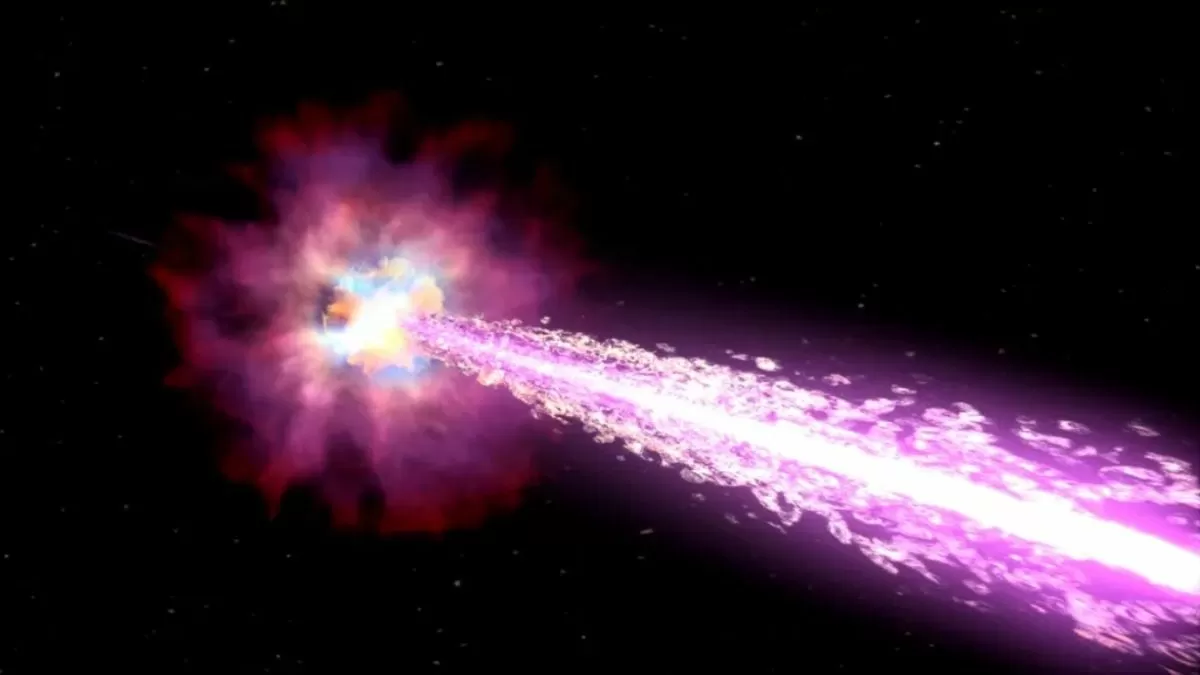
GRBs are the most energetic explosions in the universe, releasing an enormous amount of energy in a matter of seconds. They are believed to be caused by the collapse of massive stars or the merging of two neutron stars. These powerful bursts of gamma rays can travel vast distances, making them ideal for studying distant objects in the universe.
Using data from the Fermi Gamma-ray Space Telescope, a team of astronomers led by Dr. Konstantinos Gourgouliatos from Durham University in the UK, were able to trace the Great Wall using GRBs. They found that the structure extends beyond the previously known boundaries, covering a distance of 10 billion light-years. This means that the Great Wall is not only the largest known structure in the universe, but it is also the most massive, containing more than 830 trillion suns.
But that’s not all. The team also discovered that the Great Wall is much closer to us than previously thought. It was believed to be located at a distance of 10 billion light-years, but the new observations suggest that it is only 7 billion light-years away. This means that the Great Wall is not only larger and more massive, but it is also closer to us, making it easier to study and understand.
This groundbreaking discovery has significant implications for our understanding of the universe. It challenges the current theories of cosmic structure formation, which suggest that structures like the Great Wall should not exist on such a large scale. The new findings suggest that our current models may need to be revised to account for the existence of such massive structures.
The Great Wall is not just a random cluster of galaxies; it is a crucial piece of the puzzle in understanding the evolution of the universe. It is believed to have formed around 2 billion years after the Big Bang, making it one of the oldest and most massive structures in the universe. By studying the Great Wall, astronomers can gain valuable insights into the early stages of the universe and how it has evolved over billions of years.
The discovery of a more massive and closer Great Wall is a testament to the power of scientific exploration and the advancements in technology that have made it possible. It is a reminder that there is still so much we have yet to discover and understand about our vast and mysterious universe.
The team’s findings have been published in the Monthly Notices of the Royal Astronomical Society, and it has already sparked excitement and interest among the scientific community. Dr. Gourgouliatos and his team are now planning to conduct further studies to gain a better understanding of the Great Wall and its role in the evolution of the universe.
In conclusion, the discovery of a more massive and closer Hercules–Corona Borealis Great Wall is a significant milestone in our quest to understand the universe. It has challenged our current theories and opened up new avenues for research. As we continue to unravel the mysteries of the universe, we can only imagine what other wonders await us in the vastness of space.