

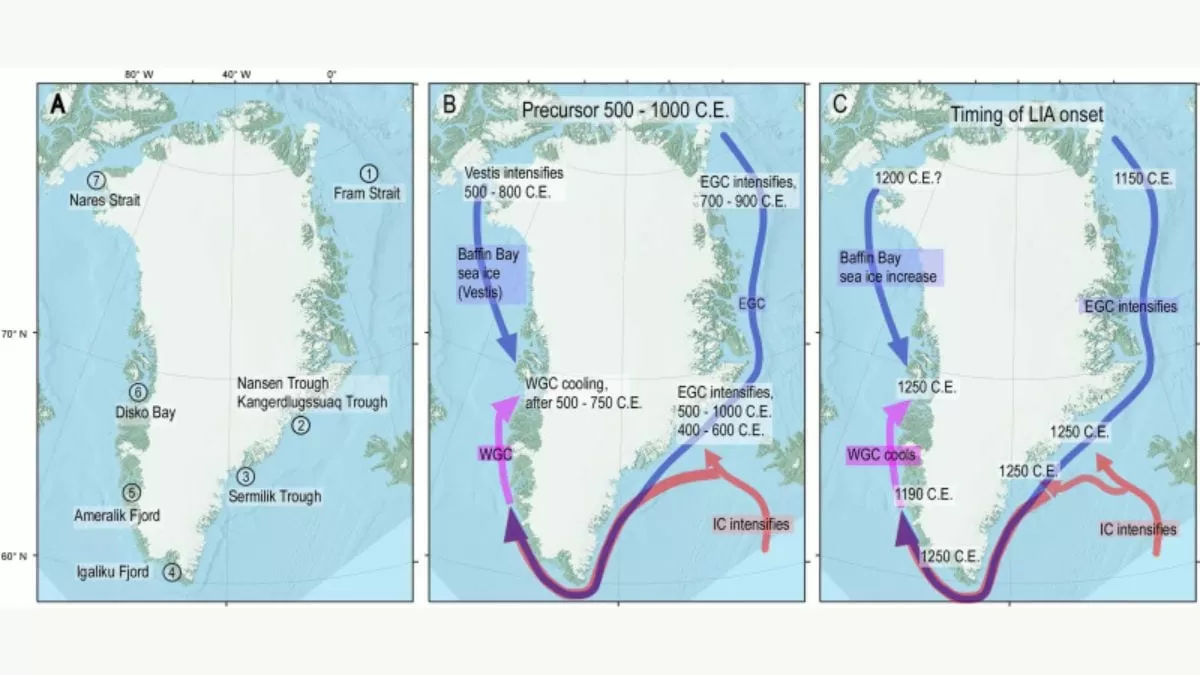
A recent study conducted by geologists Christopher Spencer, Ross Mitchell, and Thomas Gernon has shed new light on the climate anomalies of the past and provided crucial data for future climate predictions. The study, which was published in the year 2025, has identified ancient Greenland rocks embedded in Icelandic cliffs, providing evidence of glacial expansion during the Late Antique Little Ice Age (LALIA).
The team of geologists, led by Christopher Spencer, has been studying the geological history of Iceland for several years. Their research has focused on understanding the impact of climate change on the island and how it has shaped its landscape over time. However, their latest discovery has taken their research to a whole new level.
The team’s findings, published in the prestigious journal Nature, have revealed that the Icelandic cliffs contain rocks that originated from Greenland over 1500 years ago. These rocks were transported by icebergs during the Late Antique Little Ice Age, a period of global cooling that occurred between the 6th and 9th centuries. This discovery confirms the expansion of glaciers during this time, providing valuable insights into the Earth’s past climate.
According to Ross Mitchell, one of the co-authors of the study, the discovery of these ancient Greenland rocks in Icelandic cliffs is a significant breakthrough. He explains, “These rocks serve as a time capsule, providing us with a glimpse into the Earth’s past climate. They confirm that the Late Antique Little Ice Age was a global phenomenon, and not just limited to certain regions.”
The team’s research also suggests that the glacial expansion during the LALIA was caused by a combination of factors, including volcanic eruptions, changes in solar activity, and natural climate cycles. This finding is crucial as it helps us understand the complex nature of climate change and its various drivers.
Thomas Gernon, another co-author of the study, emphasizes the importance of their findings for future climate predictions. He says, “Studying the Earth’s past climate is crucial for understanding the current and future climate scenarios. Our research provides valuable data that can be used to improve climate models and make more accurate predictions.”
The team’s study has also sparked interest among other scientists in the field. Dr. Maria Lopez, a climate scientist at the University of Cambridge, says, “The discovery of these ancient Greenland rocks in Icelandic cliffs is a significant contribution to our understanding of past climate change. It provides us with a new perspective on the Earth’s climate history and helps us fill in the gaps in our knowledge.”
The team’s findings have also caught the attention of policymakers and environmentalists. The evidence of glacial expansion during the LALIA serves as a reminder of the Earth’s vulnerability to climate change. It highlights the need for immediate action to mitigate the effects of global warming and protect our planet for future generations.
In conclusion, the 2025 study led by geologists Christopher Spencer, Ross Mitchell, and Thomas Gernon has provided valuable insights into the Earth’s past climate and its implications for the future. The discovery of ancient Greenland rocks in Icelandic cliffs is a testament to the team’s dedication and hard work. Their research serves as a reminder of the importance of studying the Earth’s history to better understand and prepare for the challenges of the future.