

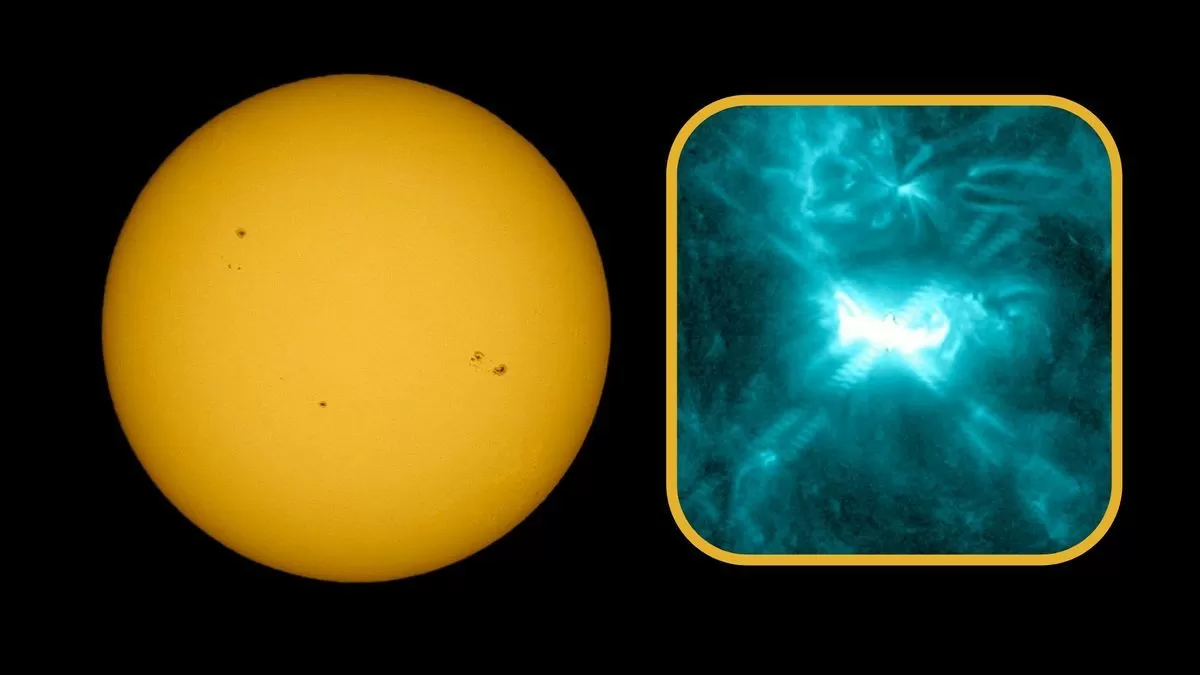
After a period of relative calm, the Sun has once again reminded us of its immense power and unpredictability. On August 3-4, 2025, three M-class solar flares erupted from active sunspot region AR 4168, releasing intense radiation and causing potential disruptions to our daily lives.
For 22 days, the Sun had been relatively quiet, with no major solar flares or coronal mass ejections (CMEs) observed. This period of solar calm was a welcome relief for scientists and space weather forecasters, who closely monitor the Sun’s activity for any potential threats to Earth.
However, on August 3, the Sun suddenly came to life, unleashing three M-class solar flares in quick succession. These moderate flares, while not as powerful as the strongest X-class flares, still pack a punch and can have significant impacts on our planet.
The first flare, classified as an M5.2, erupted at 10:23 UTC, followed by an M6.5 at 13:03 UTC and an M5.9 at 16:22 UTC on August 3. All three flares originated from the same active sunspot region, AR 4168, which had been closely monitored by scientists for its potential to produce solar flares.
These flares released intense bursts of radiation, including X-rays and ultraviolet light, which can have a range of effects on Earth. The most immediate impact was the disruption of high-frequency radio signals, which are used for communication and navigation purposes. This disruption was short-lived, lasting only a few minutes, but it serves as a reminder of the Sun’s ability to interfere with our technology.
In addition to the disruption of radio signals, these flares also have the potential to cause auroras at high latitudes. Auroras, also known as the Northern and Southern Lights, are a stunning natural phenomenon caused by charged particles from the Sun interacting with Earth’s atmosphere. While these auroras are a beautiful sight to behold, they can also cause disruptions to power grids and satellite communications.
But perhaps the most significant concern with these solar flares is the possibility of a coronal mass ejection (CME). A CME is a massive eruption of plasma and magnetic field from the Sun’s corona, which can travel through space and potentially impact Earth’s magnetic field. If a CME is directed towards Earth, it can cause a geomagnetic storm, which can disrupt power grids, satellite communications, and even pose a risk to astronauts in space.
Fortunately, in this case, scientists did not detect any significant CMEs associated with these M-class flares. However, the potential for a CME is always a concern when dealing with solar flares, and scientists will continue to monitor the situation closely.
The recent solar flares serve as a reminder of the importance of studying and understanding the Sun’s activity. The Sun is a dynamic and complex star, and its behavior can have significant impacts on our planet. By closely monitoring the Sun’s activity, scientists can provide early warnings and help mitigate any potential impacts on Earth.
In recent years, there has been a growing interest in space weather and its potential effects on our technology-dependent society. Governments and organizations around the world have invested in research and technology to better understand and predict solar activity. This investment has paid off, as we were able to detect and monitor these M-class flares and their potential impacts.
The recent solar flares also highlight the need for continued research and development in this field. With the advancement of technology, we are now able to observe the Sun in more detail than ever before. This allows us to better understand its behavior and improve our forecasting capabilities.
In conclusion, the recent M-class solar flares on August 3-4, 2025, serve as a reminder of the Sun’s immense power and its potential impacts on our planet. While these flares caused some disruptions, they also provide valuable insights and data for scientists to continue their research and improve our understanding of the Sun. With continued investment and advancements in technology, we can better prepare for and mitigate the effects of solar activity on our daily lives.