

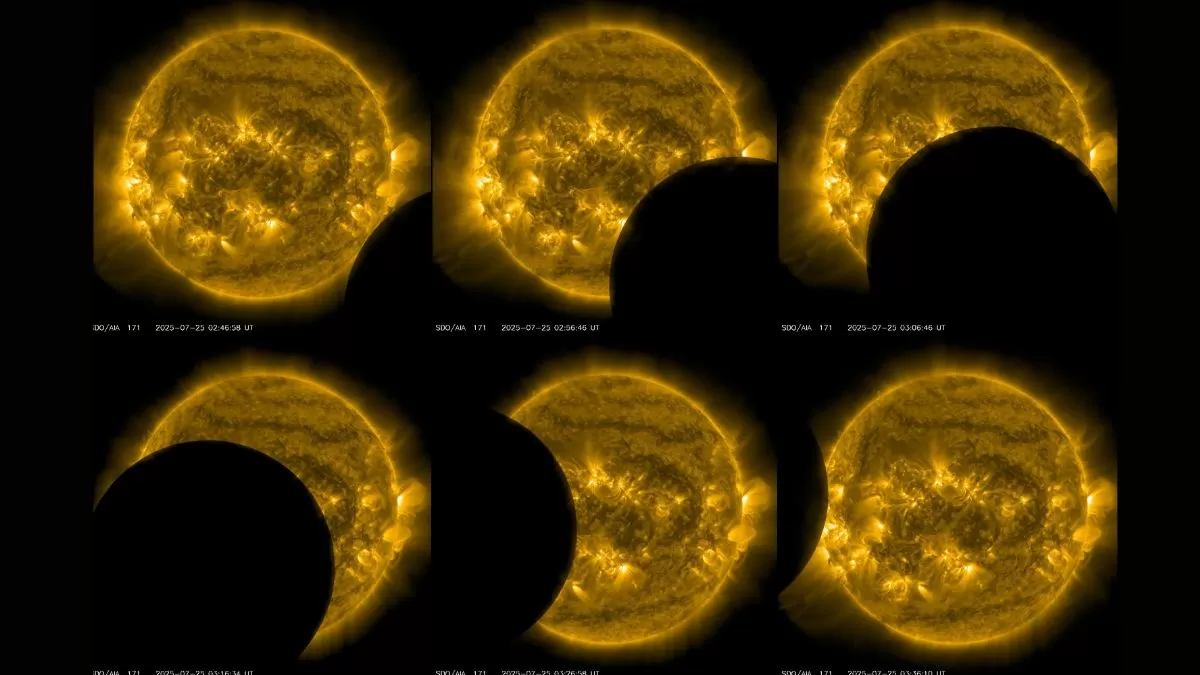
In a rare celestial event, NASA’s Solar Dynamics Observatory (SDO) recently captured not one, but two eclipses on July 25, 2025. This incredible occurrence has left scientists and astronomers in awe, as it is not often that such a phenomenon is observed.
The first eclipse, which took place at 2:45 UTC, was caused by the Moon passing between SDO and the Sun. This resulted in the Moon covering approximately 62% of the solar disk, creating a partial solar eclipse. Just a few hours later, at 6:30 UTC, another eclipse took place. This time, it was Earth itself that blocked the Sun entirely from SDO’s perspective, causing a total solar eclipse.
These dual eclipses were not a coincidence, as they occurred during SDO’s eclipse season. This is a period of time when the spacecraft’s orbit around Earth aligns with the Sun, making it easier to capture eclipses. However, it is still a rare event to witness two eclipses in a single day.
The SDO is a NASA satellite that has been observing the Sun since its launch in 2010. It is equipped with advanced instruments and cameras that allow it to capture high-resolution images and videos of the Sun. These observations have helped scientists gain a better understanding of the Sun’s behavior and its impact on Earth.
The SDO’s primary mission is to study the Sun’s magnetic field and its solar activity, which includes solar flares, coronal mass ejections, and other solar phenomena. By constantly monitoring the Sun, the SDO has been able to provide valuable data and insights about our nearest star.
The dual eclipses on July 25, 2025, were not only a rare event but also a testament to the SDO’s capabilities. Capturing these eclipses required precise timing and positioning, which the SDO was able to achieve flawlessly. This achievement is a testament to the hard work and dedication of the scientists and engineers behind the SDO mission.
These eclipses also served as a reminder of the constant dance between the Earth, Moon, and Sun. As the Moon orbits the Earth, it occasionally passes between the Sun and the Earth, causing a solar eclipse. Similarly, as the Earth orbits the Sun, it casts a shadow on the Moon, resulting in a lunar eclipse. These celestial events never fail to fascinate us and remind us of our place in the vastness of the universe.
The SDO’s observations of the eclipses also provided valuable data for scientists to study. During the total solar eclipse, the SDO was able to capture images of the Sun’s corona, the outermost layer of the Sun’s atmosphere. This is an area that is usually difficult to study because the Sun’s bright surface usually obscures it. By capturing images during the total solar eclipse, scientists were able to study the corona in more detail and possibly uncover new information about it.
Moreover, the partial solar eclipse caused by the Moon’s passage also provided valuable data. By measuring the amount of sunlight blocked by the Moon, scientists were able to calculate the thickness and composition of the Moon’s atmosphere. This data can help us better understand the Moon and its formation.
The dual eclipses of July 25, 2025, were truly a sight to behold. They not only provided a rare and beautiful spectacle but also served as a reminder of the continuous scientific advancements and discoveries being made. The SDO’s observations of these eclipses have provided valuable data for scientists to study and learn more about the Sun, Moon, and Earth.
As we continue to explore the wonders of our universe, events like these remind us of the infinite possibilities and mysteries that await us. And thanks to the SDO and other advanced technologies, we are able to witness and learn from these events in ways that were once unimaginable.
In conclusion, the dual eclipses captured by NASA’s SDO on July 25, 2025, were a remarkable and rare event that left scientists and astronomy enthusiasts in awe. These eclipses not only provided a stunning display but also provided valuable data for further research and study. As we continue to push the boundaries of space exploration, we can only imagine what other incredible events and discoveries await us in the future.