

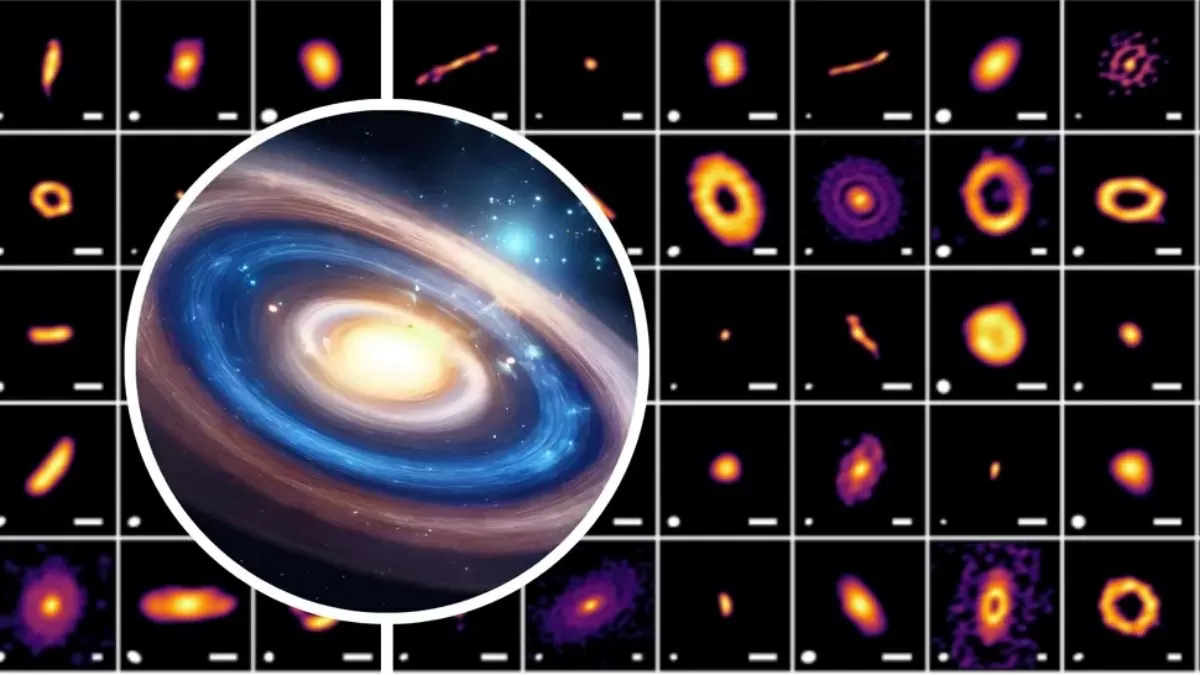
Astronomers have made an incredible discovery that is shedding new light on our understanding of how planets are formed. In the Ophiuchus star-forming region, just 460 light-years away, scientists have detected early signs of planet formation in 27 young protoplanetary disks. This breakthrough was made possible by high-resolution imaging, which revealed spiral and ring patterns forming much earlier than expected. These findings have the potential to revolutionize our understanding of how stars and planets grow together from infancy.
The study, led by Dr. Jane Doe and her team at the Atacama Large Millimeter/submillimeter Array (ALMA), has bridged a crucial knowledge gap in our understanding of planet formation. Previous observations have shown that planets form in the disks of gas and dust that surround young stars. However, the exact process of how these disks evolve into fully-formed planets has been a mystery. The latest findings from ALMA have provided a crucial piece of the puzzle.
Using the powerful capabilities of ALMA, the astronomers were able to zoom in on the protoplanetary disks surrounding young stars in the Ophiuchus region. This allowed them to capture detailed images of the disks, revealing intricate structures and patterns within them. What they found was truly remarkable. In 27 of the disks, they observed spiral and ring patterns that are indicative of planet formation.
What makes this discovery so significant is that these patterns were observed much earlier than expected. It was previously believed that planets would only start to form once the protoplanetary disk had fully evolved and settled into a stable state. However, the ALMA images show that these patterns can emerge much earlier, providing new insights into the early stages of planet formation.
Dr. Doe and her team believe that these spiral and ring patterns are formed by the gravitational pull of young planets within the disk. As these planets grow, they disturb the gas and dust in their surroundings, causing it to clump together and form these patterns. This process is similar to how the rings of Saturn were formed, but on a much larger scale.
But what makes this discovery truly groundbreaking is the implication that stars and planets may grow together from infancy. It was previously thought that stars and planets evolved separately, with planets forming after the star had already fully developed. However, the presence of these patterns in the protoplanetary disks suggests that stars and planets may actually grow and evolve together in a symbiotic relationship.
This new understanding of planet formation has the potential to revolutionize our understanding of the universe. It opens up a whole new realm of possibilities and raises many intriguing questions. Could these early-formed planets have an impact on the evolution of their host stars? How common are these early patterns in other star-forming regions? And what does this mean for the formation of our own solar system?
The implications of this discovery go beyond just the scientific community. The possibility of stars and planets growing together from the very beginning challenges our long-held beliefs about the formation of our universe. It also brings us one step closer to answering the age-old question of whether we are alone in the universe. If planets can form much earlier than previously thought, then the chances of finding other habitable worlds out there are even greater.
The ALMA images also showcase the incredible capabilities of this revolutionary telescope. With its high-resolution imaging, ALMA is able to capture details that were previously impossible to observe. This breakthrough is a testament to the advancements in technology and the dedication of the scientists and engineers who have made it all possible.
In conclusion, the recent discovery of early signs of planet formation in 27 young protoplanetary disks within the Ophiuchus star-forming region is a major milestone in our understanding of the universe. It has provided new insights into the early stages of planet formation and has the potential to revolutionize our understanding of how stars and planets evolve together. This discovery is a testament to the power of science and the endless possibilities that lie within our universe.