

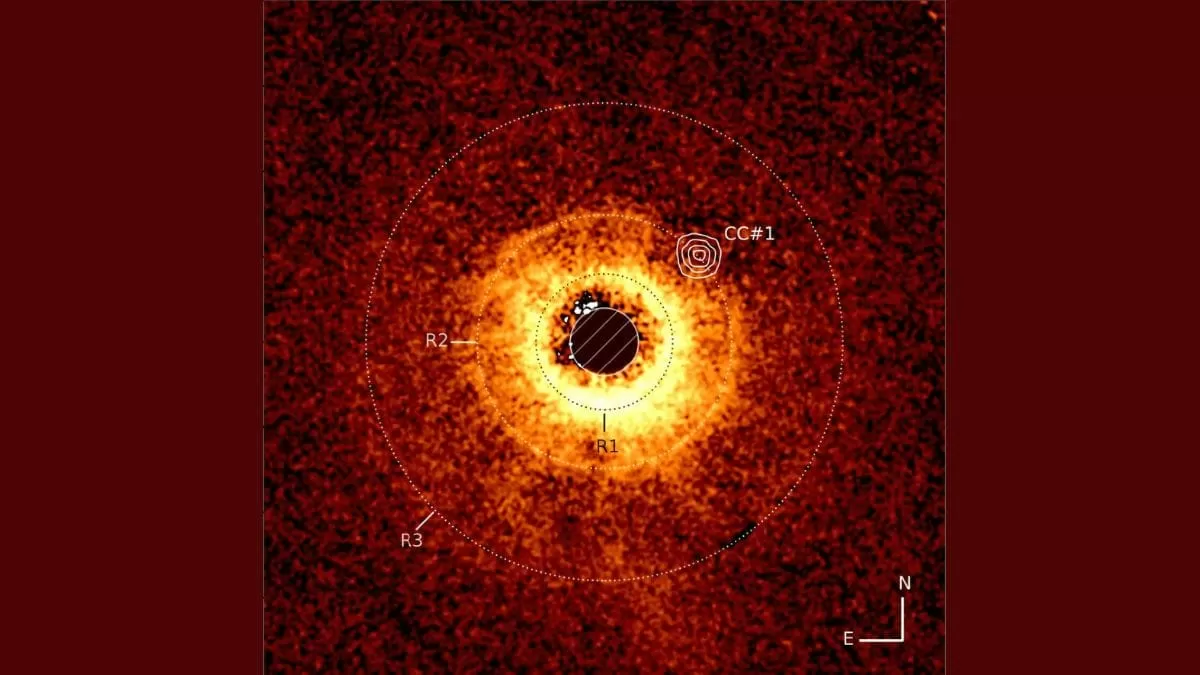
NASA’s James Webb Space Telescope has achieved a groundbreaking milestone in the field of space exploration. The telescope has captured its first direct image of TWA 7 b, a newly discovered Saturn-mass exoplanet orbiting the young star TWA 7. This remarkable discovery is a result of years of hard work, dedication, and cutting-edge technology.
The James Webb Space Telescope, also known as Webb, is the world’s most powerful and complex space telescope. It is a joint project between NASA, the European Space Agency (ESA), and the Canadian Space Agency (CSA). After years of preparation and development, Webb was finally launched into orbit in December 2021, marking a major milestone in space exploration.
Webb is designed to study the universe’s earliest galaxies and search for potential life-supporting planets outside our solar system. Its main mission is to unravel the mysteries of the universe, from the formation of galaxies to the birth of stars and planets. And with its latest achievement, Webb has proven its capabilities and potential to revolutionize our understanding of the universe.
TWA 7 b is the smallest exoplanet ever imaged directly, and its discovery is a significant step forward in the search for habitable worlds. Exoplanets are planets that orbit stars other than our Sun, and TWA 7 b is one such planet. Located approximately 369 light-years from Earth, this Jupiter-sized planet is orbiting a young star, TWA 7, which is only about 10 million years old. This age is relatively young in terms of astronomical timescales, making TWA 7 an immensely exciting target for scientists.
But what makes this discovery even more remarkable is that TWA 7 b was spotted using a coronagraph, a device that blocks the star’s bright light to reveal the faint planets orbiting it. This is the first time a coronagraph has been used successfully by any space telescope to directly image an exoplanet. It is a major feat and a testament to the advanced technology of the James Webb Space Telescope.
The image captured by Webb shows TWA 7 b nestled among the dusty ring system of its parent star, making it look like a small dot in a vast expanse of space. This image is a groundbreaking achievement and a glimpse into the capabilities of the Webb telescope. It is a crucial step towards understanding the formation and evolution of young planetary systems.
The discovery of TWA 7 b is also significant because it adds to the growing list of exoplanets that have been directly imaged. Till now, only a few exoplanets have been captured directly, and each one provides valuable insight into the diversity and complexity of the universe. And with Webb’s advanced imaging capabilities, it is expected that many more exoplanets will be discovered in the future, bringing us closer to understanding the unknown corners of our universe.
This discovery also highlights the importance of collaboration and international cooperation in the field of space exploration. The James Webb Space Telescope is a joint effort of NASA, ESA, and CSA, and the success of this mission is a result of the combined efforts of these space agencies. It is a reminder that great things can be achieved when we work together towards a common goal.
The James Webb Space Telescope is expected to continue its scientific observations for the next decade, providing us with invaluable data and images of the universe. With its powerful instruments and advanced technology, we can expect more groundbreaking discoveries in the future. And with each new discovery, we come one step closer to unraveling the mysteries of the universe and understanding our place in it.
In conclusion, the first direct image of TWA 7 b by the James Webb Space Telescope is a significant milestone in space exploration. It not only showcases Webb’s capabilities but also opens up a whole new realm of possibilities for future discoveries. This achievement is a testament to the hard work and dedication of the scientists and engineers involved in the Webb mission and a reminder of the wonders that can be achieved through international collaboration. We can only imagine what other wonders Webb will reveal to us in the years to come, and we eagerly await the next groundbreaking discovery.