

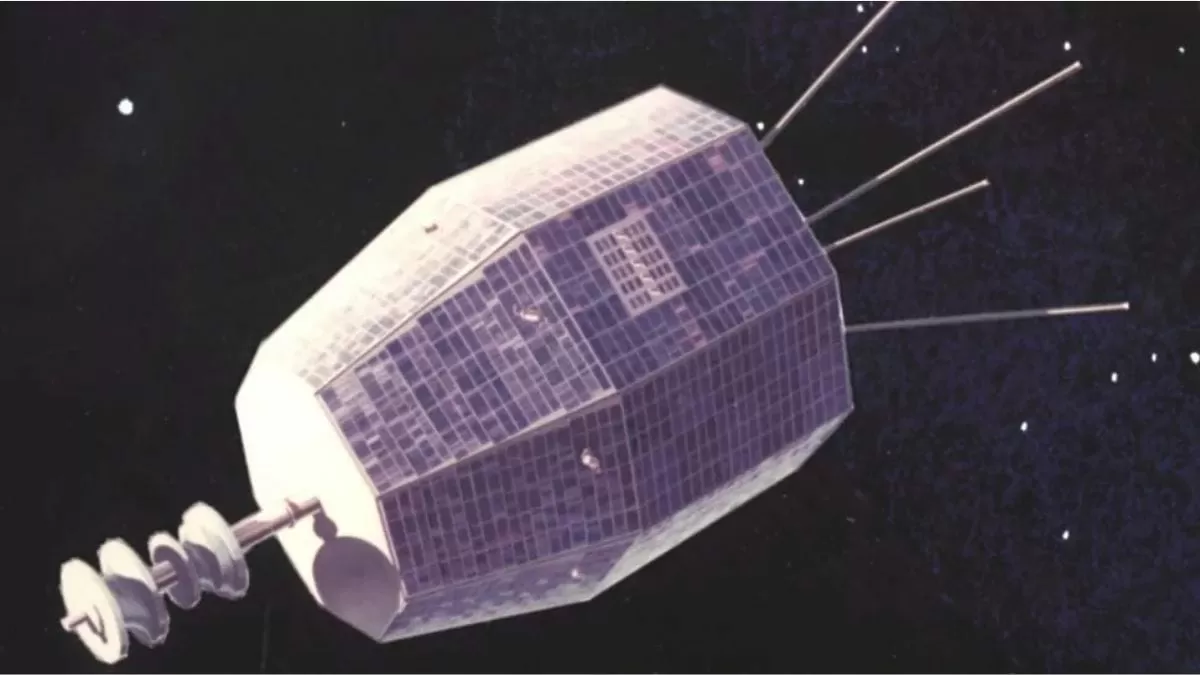
In June of 2024, a strange occurrence baffled scientists and astrophysicists around the world. A 30-nanosecond radio burst was detected, leaving experts perplexed and searching for answers. After months of rigorous analysis and investigation, the source of the mysterious signal was finally uncovered – Relay 2, a NASA satellite that had been offline since 1967.
This groundbreaking discovery was made possible by a team of dedicated researchers who were determined to unlock the secrets of the universe. Their findings, detailed in a new preprint study, have shed light on the capabilities of defunct satellites and their potential to continue contributing to scientific advancement.
The story began when the radio telescope located at the University of Manchester’s Jodrell Bank Observatory in the UK detected the strange signal. The burst, lasting only 30 nanoseconds, was unlike any other radio signals previously recorded. It was a moment of excitement and confusion for the team of scientists, who immediately began their investigation.
Initially, the signal was believed to be of extraterrestrial origin, as this has been a possibility that scientists have been exploring for decades. However, as the team dug deeper, they found evidence that pointed to a more surprising source – Relay 2, a satellite that had not transmitted any signal since the late 1960s.
Relay 2 was launched in 1964 as part of the NASA’s experimental communication satellite program. Its purpose was to relay television and telephony signals between the United States, Europe, and Africa. However, the satellite stopped functioning in 1967 and has since remained silent – until now.
The team of researchers found that the satellite’s sudden burst of radio signal could have been triggered either by a micrometeorite impact or an electrostatic discharge. These occurrences can cause a buildup of energy, which could have been released in the form of the 30-nanosecond radio burst.
The discovery of Relay 2’s role in the mysterious radio signal has opened up a whole new realm of possibilities for scientists. It has shown that even defunct satellites have the potential to contribute to scientific research and advancements. This is a significant finding, as many old satellites are still orbiting the Earth and could potentially provide valuable data that could further our understanding of the universe.
This discovery also highlights the importance of continuing to monitor and study space debris and defunct satellites. Often, these objects are considered to be nothing more than space junk, but this discovery has proven that they can still hold valuable information and contribute to scientific progress.
The research team behind this remarkable discovery hopes that their findings will encourage more efforts to track and study defunct satellites. They believe that this could lead to further groundbreaking discoveries and advancements in the field of space exploration.
Furthermore, this discovery serves as a reminder of the dedication and persistence of scientists and researchers. They never cease to amaze us with their ability to unravel the mysteries of the universe and push the boundaries of our knowledge.
The team’s discovery of Relay 2’s role in the radio burst has also reignited interest in the possibility of extraterrestrial life and the search for intelligent beings beyond our solar system. The possibility of receiving signals from other civilizations is something that has fascinated scientists and the general public for decades. This discovery has shown that the universe is full of surprises, and we must continue to explore and discover its secrets.
In conclusion, the mysterious 30-nanosecond radio burst detected in June 2024 has been revealed to have come from a source that no one could have predicted – a NASA satellite that has been offline for over 50 years. The discovery of Relay 2’s involvement in the signal highlights the potential of defunct satellites to contribute to scientific research. It is a testament to the dedication and perseverance of scientists and their ability to uncover the mysteries of the universe. This discovery opens up new possibilities and reignites our curiosity about what lies beyond our planet. As we continue to explore the vast expanse of space, who knows what other secrets and surprises we may uncover. The possibilities are endless, and the future of space exploration is exciting.