

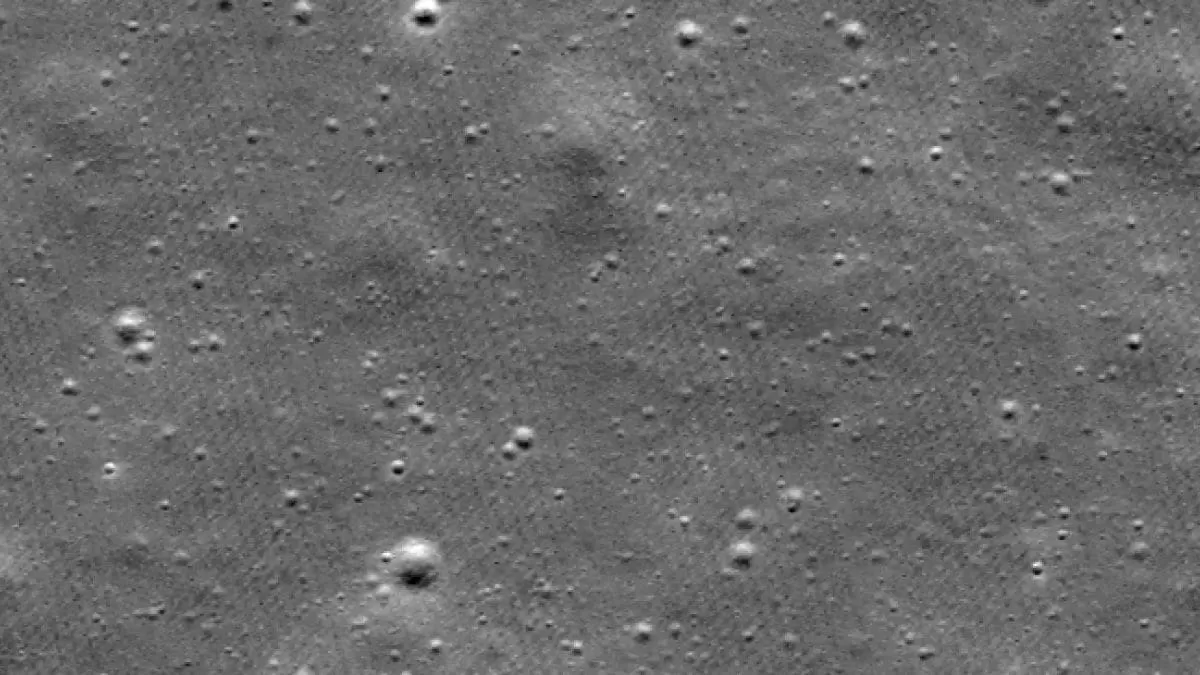
NASA’s Lunar Reconnaissance Orbiter and India’s Chandrayaan-2 have once again proven their capabilities by capturing images of the impact of Japan’s Resilience lander on the Moon’s Mare Frigoris. After losing contact with the lander just 100 seconds before its scheduled touchdown on June 5, the latest photos reveal a dark impact mark and scattered debris, providing valuable insights into the dynamics of lunar landings.
The Resilience lander, developed by the Japanese Aerospace Exploration Agency (JAXA), was a part of the H-II Transfer Vehicle-9 (HTV-9) mission, which was launched on May 20, 2020, from the Tanegashima Space Center. Its primary objective was to deliver supplies and equipment to the International Space Station (ISS), but it also carried the Resilience lander as a secondary payload to the Moon.
Unfortunately, the mission faced a setback when communication with the lander was lost just moments before its scheduled touchdown on the Moon’s surface. JAXA officials confirmed that the lander had crashed, but the exact location and extent of the impact were still unknown.
However, NASA’s Lunar Reconnaissance Orbiter (LRO) and India’s Chandrayaan-2 spacecraft were able to provide crucial information about the crash. The LRO, a robotic spacecraft orbiting the Moon since 2009, captured images of the impact site on June 17, 2020, using its high-resolution camera. The images revealed a dark impact mark and scattered debris, which were not present in previous images of the same area.
The Chandrayaan-2 orbiter, which has been orbiting the Moon since September 2019, also captured images of the impact site on June 19, 2020. The images, taken by its Terrain Mapping Camera-2 (TMC-2), showed a bright halo around the impact site, indicating the presence of ejected material.
These images confirm the crash of the Resilience lander and provide valuable information about the dynamics of lunar landings. The dark impact mark indicates that the lander hit the surface with a significant force, while the scattered debris suggests that it broke into multiple pieces upon impact.
The LRO and Chandrayaan-2 missions have once again demonstrated their importance in providing crucial data and insights into lunar exploration. These spacecraft have been instrumental in studying the Moon’s surface and its evolution, as well as providing support for future missions.
The LRO, operated by NASA’s Goddard Space Flight Center, is equipped with seven scientific instruments, including cameras, spectrometers, and a laser altimeter. Its primary mission is to create a comprehensive map of the Moon’s surface and study its resources, environment, and potential for human exploration.
Chandrayaan-2, a joint mission of the Indian Space Research Organization (ISRO) and the Indian Space Science Data Center (ISSDC), is India’s second lunar exploration mission. It consists of an orbiter, a lander, and a rover, with the main objective of studying the Moon’s south polar region and searching for water molecules.
The successful capture of images of the Resilience lander crash by these spacecraft highlights the importance of international collaborations in space exploration. These missions have not only provided valuable data but have also strengthened the bond between different space agencies.
The images of the impact site also serve as a reminder of the challenges and risks involved in space exploration. Despite the best efforts and advanced technology, accidents can still occur. However, these setbacks should not discourage us from pursuing our dreams of exploring the unknown and expanding our knowledge of the universe.
The latest images of the Resilience lander crash also serve as a motivation to continue our efforts in exploring the Moon and other celestial bodies. With the advancement of technology and the collaboration between different space agencies, we can continue to push the boundaries of space exploration and make new discoveries.
In conclusion, the images captured by NASA’s LRO and India’s Chandrayaan-2 have confirmed the crash of Japan’s Resilience lander on the Moon’s Mare Frigoris. These images provide valuable insights into the dynamics of lunar landings and highlight the importance of international collaborations in space exploration. The mission may have faced a setback, but it serves as a reminder of the challenges and risks involved in exploring the unknown. Let us use this as motivation to continue our efforts and explore the wonders of the