

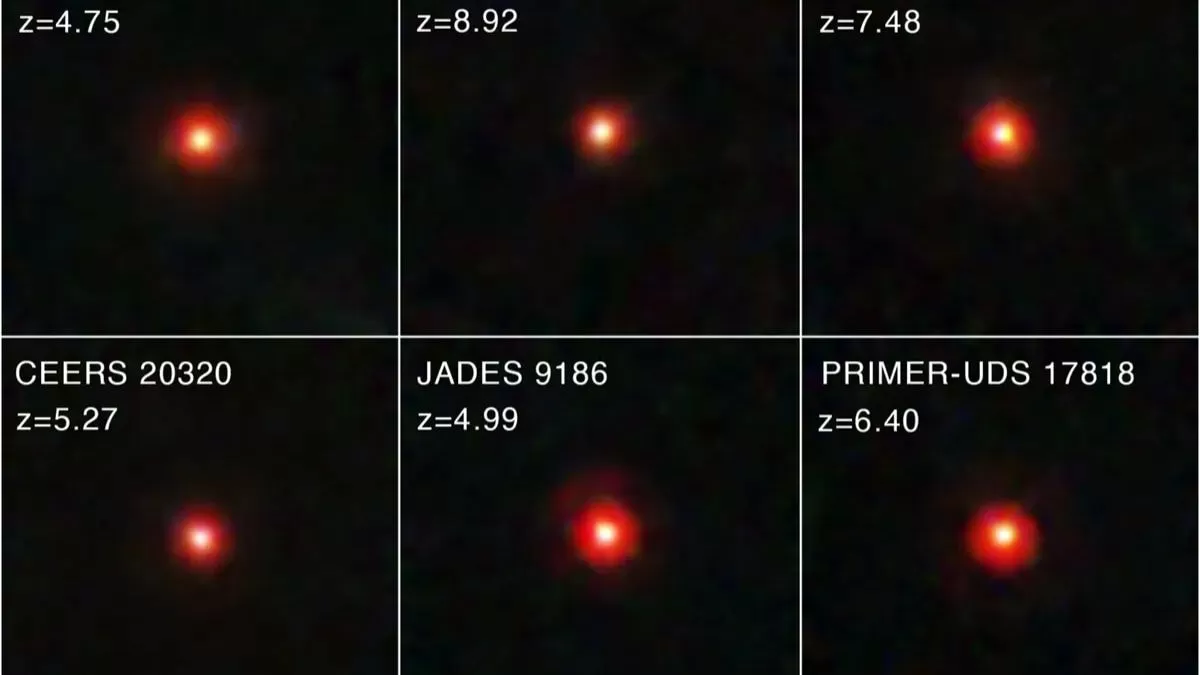
The universe is full of mysteries waiting to be unraveled, and one of the most intriguing ones is the relationship between quasars and Little Red Dots. For years, scientists have been trying to understand this cosmic puzzle, and now, thanks to new research using the James Webb Space Telescope, we may finally have some answers. A study published on May 7, 2025, in arXiv has revealed a population of dust-obscured supermassive black holes in the early universe, bringing us one step closer to solving the cosmic mystery.
Quasars, also known as “quasi-stellar objects,” are among the brightest and most energetic objects in the universe. They are powered by supermassive black holes at the center of galaxies, which are surrounded by a swirling disk of gas and dust. As the black hole devours this material, it emits intense radiation, making quasars visible from billions of light-years away. On the other hand, Little Red Dots are small, faint galaxies that are thought to be the building blocks of larger galaxies. They are characterized by their red color, which is caused by the presence of old, red stars.
For decades, scientists have been puzzled by the connection between these two seemingly different objects. How do quasars and Little Red Dots relate? Are they two separate phenomena, or are they somehow connected? These questions have been the subject of intense research, and now, with the help of the James Webb Space Telescope, we may finally have some answers.
The James Webb Space Telescope, or JWST, is the most powerful and advanced space telescope ever built. It is a joint project between NASA, the European Space Agency, and the Canadian Space Agency, and it is set to launch in 2021. With its advanced technology and capabilities, the JWST will be able to peer deeper into the universe than ever before, allowing us to study the most distant and ancient objects in the cosmos.
In the recent study published in arXiv, a team of astronomers used the JWST to observe a sample of quasars and Little Red Dots in the early universe. They found that a significant number of these objects were obscured by dust, making them invisible to traditional telescopes. This discovery has shed light on the relationship between quasars and Little Red Dots, as it suggests that they may be two different stages in the evolution of galaxies.
According to the researchers, the dust-obscured quasars observed by the JWST are likely in the process of merging with other galaxies, which could explain their red color and their connection to Little Red Dots. This finding is significant because it provides a possible explanation for the link between these two objects, which has been a mystery for so long.
The study also has implications for our understanding of the early universe. By studying these dust-obscured objects, we can learn more about the formation and evolution of galaxies in the early universe, which is crucial for understanding how our own galaxy, the Milky Way, came to be.
The discovery of this population of dust-obscured supermassive black holes is just the beginning. With the launch of the JWST and the advancements in technology, we can expect to uncover even more secrets of the universe. The JWST will allow us to study the most distant and ancient objects in the cosmos, giving us a glimpse into the early stages of the universe and helping us piece together the puzzle of our cosmic origins.
The implications of this study are immense, and it is a testament to the power of scientific research and exploration. The James Webb Space Telescope is a testament to human ingenuity and our insatiable curiosity about the universe. It is a reminder that there is still so much to discover and learn about the vast expanse of space that surrounds us.
In conclusion, the cosmic mystery of how quasars and Little Red Dots relate may soon be solved, thanks to the groundbreaking research using the James Webb Space Telescope. The recent study published in arXiv has revealed a population of dust-obscured supermassive black holes in the early universe, providing a possible explanation for the connection between these two objects. With the launch of the JWST and the advancements in technology, we can expect to uncover even more secrets of the universe and continue to push the boundaries of our understanding of the cosmos. The future of space exploration is bright, and we can’t wait to see what other mysteries it