

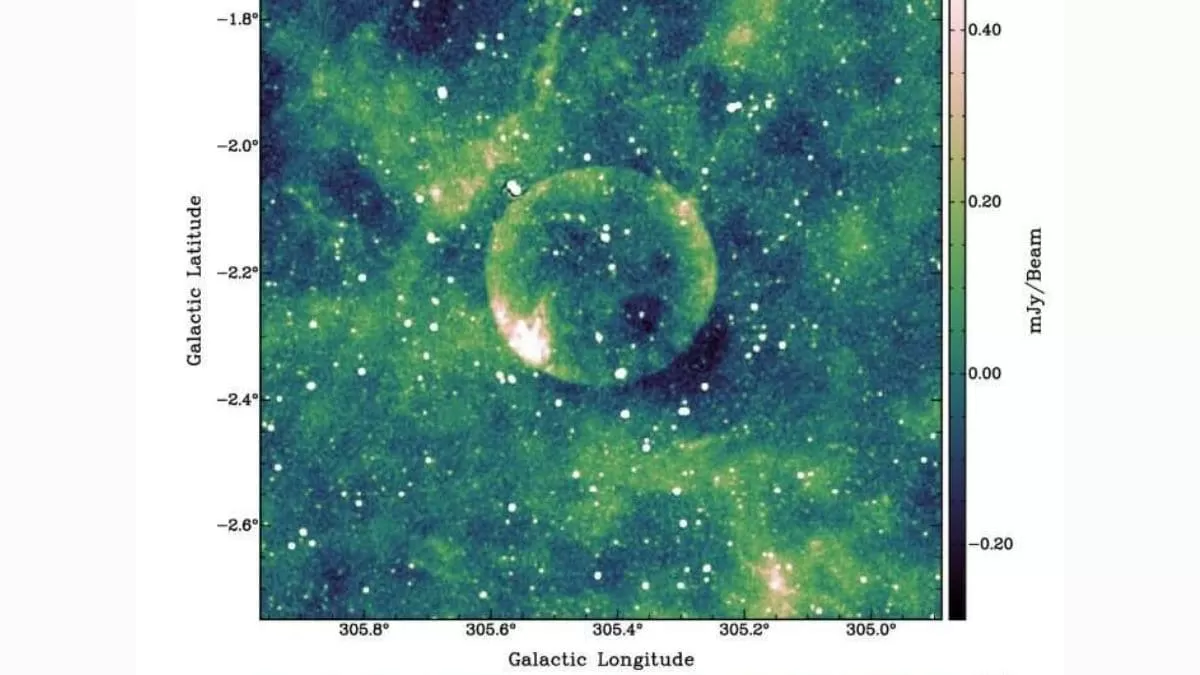
A new discovery in the universe has left scientists in awe. Named “Teleios,” which means “perfect” in Greek, this newly discovered supernova remnant is astonishing in its rare circular symmetry. Detected using data from ASKAP’s Evolutionary Map of the Universe, Teleios (G305.4-2.2) is located either 7,170 or 25,100 light years away. With a steep spectral index and low surface brightness, the origin of this phenomenon is believed to be a…
The discovery of Teleios has been a breakthrough in the field of astronomy. Its perfect circular shape has captured the attention of scientists all over the world. This supernova remnant has been named after the Greek word “Teleios,” which means perfection. And truly, this discovery is nothing short of perfect.
Using data from ASKAP’s Evolutionary Map of the Universe, scientists were able to detect this rare phenomenon. The ASKAP telescope, located in Western Australia, is known for its advanced technology and has been instrumental in many astronomical discoveries. Its Evolutionary Map of the Universe (EMU) survey aims to map the entire southern sky in radio waves, providing a new insight into the evolution of the universe.
Teleios, also known as G305.4-2.2, is located either 7,170 or 25,100 light years away. The uncertainty in its distance is due to the fact that it is located in a dense and complex region of the Milky Way, making it difficult to accurately measure its distance. Nevertheless, its discovery has left scientists thrilled and excited.
One of the most remarkable features of Teleios is its circular symmetry. This is a rare occurrence in the universe, and its perfect circular shape has puzzled scientists. The remnant’s symmetry suggests that it was formed in a relatively calm environment, unlike other supernova remnants that are often distorted due to the explosion’s violent nature.
Moreover, Teleios has a steep spectral index and low surface brightness, which is another unique characteristic of this supernova remnant. A spectral index measures how the intensity of radio waves changes with frequency, and a steep index indicates a higher concentration of radio waves. The low surface brightness of Teleios suggests that it is an old remnant, possibly formed thousands of years ago.
But the question remains, what could be the origin of this perfect and rare phenomenon? Scientists believe that Teleios is the result of a massive star’s explosion, known as a supernova. As the star ran out of fuel, it collapsed under its own gravity, resulting in a massive explosion. This explosion releases a tremendous amount of energy, which creates a shockwave that travels outward, leaving behind a supernova remnant.
The circular shape of Teleios suggests that the star’s explosion was symmetrical, with the shockwave expanding in all directions equally. This could only happen in a calm and stable environment, which is quite unusual for a supernova explosion. This discovery has opened up new avenues of research, and scientists are now trying to understand the factors that led to this rare occurrence.
The discovery of Teleios is not only significant for its perfect symmetry, but it also provides valuable insights into the evolution of the universe. The EMU survey aims to map the entire southern sky, and with this new discovery, scientists can study the evolution of supernova remnants and their role in shaping the universe.
The name “Teleios” not only reflects the perfect symmetry of this supernova remnant but also symbolizes the perfection of the universe. With each new discovery, we are reminded of the vastness and complexity of our universe, and how every aspect of it is in perfect harmony.
In conclusion, the discovery of Teleios has left scientists in awe of the wonders of the universe. Its rare circular symmetry, along with its steep spectral index and low surface brightness, has made it a fascinating subject of study. As we continue to unravel the mysteries of the universe, Teleios will remain a shining example of perfection, reminding us of the beauty and complexity of our universe.