

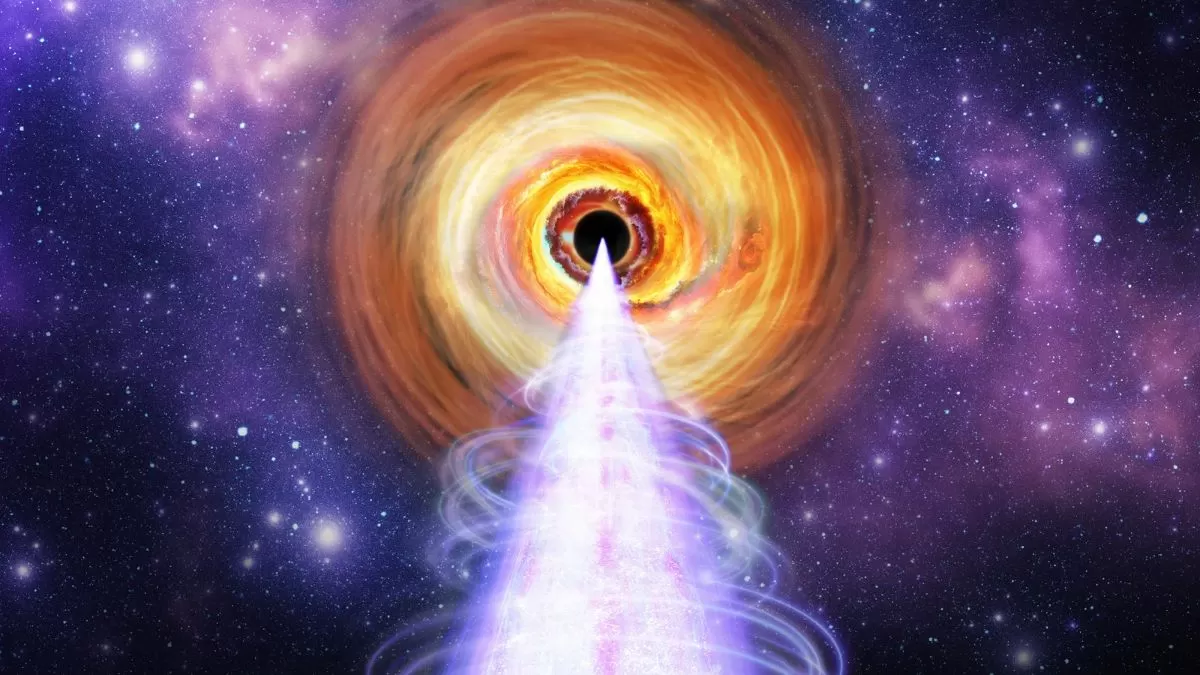
NASA’s IXPE satellite has made a groundbreaking discovery that may finally solve a longstanding mystery in astrophysics. For years, scientists have been trying to understand how X-rays are produced in the extreme jets of supermassive black holes. Thanks to the observations made by IXPE, we may now have the answer.
The satellite, which stands for Imaging X-ray Polarimetry Explorer, has been studying a blazar known as BL Lacertae. Blazars are a type of active galactic nuclei, which are supermassive black holes at the center of galaxies that are actively feeding on surrounding matter. These black holes emit powerful jets of particles and radiation, making them some of the most energetic objects in the universe.
One of the key features of blazars is their ability to emit X-rays, which are a form of high-energy electromagnetic radiation. However, the exact mechanism behind this emission has been a mystery. That is, until now.
IXPE’s observations of BL Lacertae have revealed a significant difference in the polarization of X-rays and optical light. Polarization refers to the alignment of electromagnetic waves, and it can provide valuable information about the processes happening in the source of the radiation.
In the case of BL Lacertae, IXPE recorded low X-ray polarization and very high optical polarization. This stark contrast in polarization levels has led scientists to conclude that Compton scattering is the most likely mechanism behind the production of X-rays in the blazar’s jets.
Compton scattering is a process in which high-energy photons, such as X-rays, interact with electrons and transfer some of their energy to them. This results in a change in the direction of the photons, which can then be detected by instruments like IXPE.
This breakthrough discovery is a significant step forward in our understanding of the extreme environments around supermassive black holes. It confirms that Compton scattering is the dominant mechanism for producing X-rays in blazars, which has been a subject of debate among scientists for decades.
But the implications of this discovery go beyond just understanding the production of X-rays in blazars. It also has broader implications for the study of electron-photon interactions in extreme environments, which is crucial for understanding the behavior of matter and radiation in the universe.
The electron-photon interaction is a fundamental process that occurs in various astrophysical phenomena, such as supernovae explosions, pulsars, and active galactic nuclei. By confirming Compton scattering as the mechanism behind X-ray production in blazars, IXPE’s observations have provided valuable insights into this process.
Moreover, this discovery has the potential to shed light on the origin of high-energy cosmic rays, which are particles with extremely high energies that originate from outside our solar system. These cosmic rays are thought to be produced in the jets of active galactic nuclei, and understanding the mechanisms behind X-ray production in blazars is a crucial step towards unraveling this mystery.
The success of IXPE’s mission is a testament to the power of collaboration and cutting-edge technology. The satellite is a joint effort between NASA, the Italian Space Agency, and the Italian National Institute for Astrophysics. It is equipped with state-of-the-art instruments that can measure the polarization of X-rays with unprecedented precision.
The IXPE team has been working tirelessly to analyze the data collected by the satellite and make sense of the complex processes happening in blazars. Their efforts have paid off with this groundbreaking discovery, which has the potential to revolutionize our understanding of the universe.
This breakthrough also highlights the importance of space-based observations in advancing our knowledge of the cosmos. Satellites like IXPE provide a unique vantage point for studying celestial objects, free from the interference of Earth’s atmosphere. They allow us to see the universe in a whole new light and make discoveries that would not be possible with ground-based telescopes.
In conclusion, NASA’s IXPE satellite has made a significant contribution to astrophysics with its latest discovery. By confirming Compton scattering as the mechanism behind X-ray production in blazars, it has solved a longstanding mystery and opened up new avenues for research. This breakthrough is a testament to the power of scientific collaboration and the importance of space-based observations in advancing our understanding of the universe. With IXPE’s mission still ongoing, we can only imagine what other secrets it may uncover in the future.